
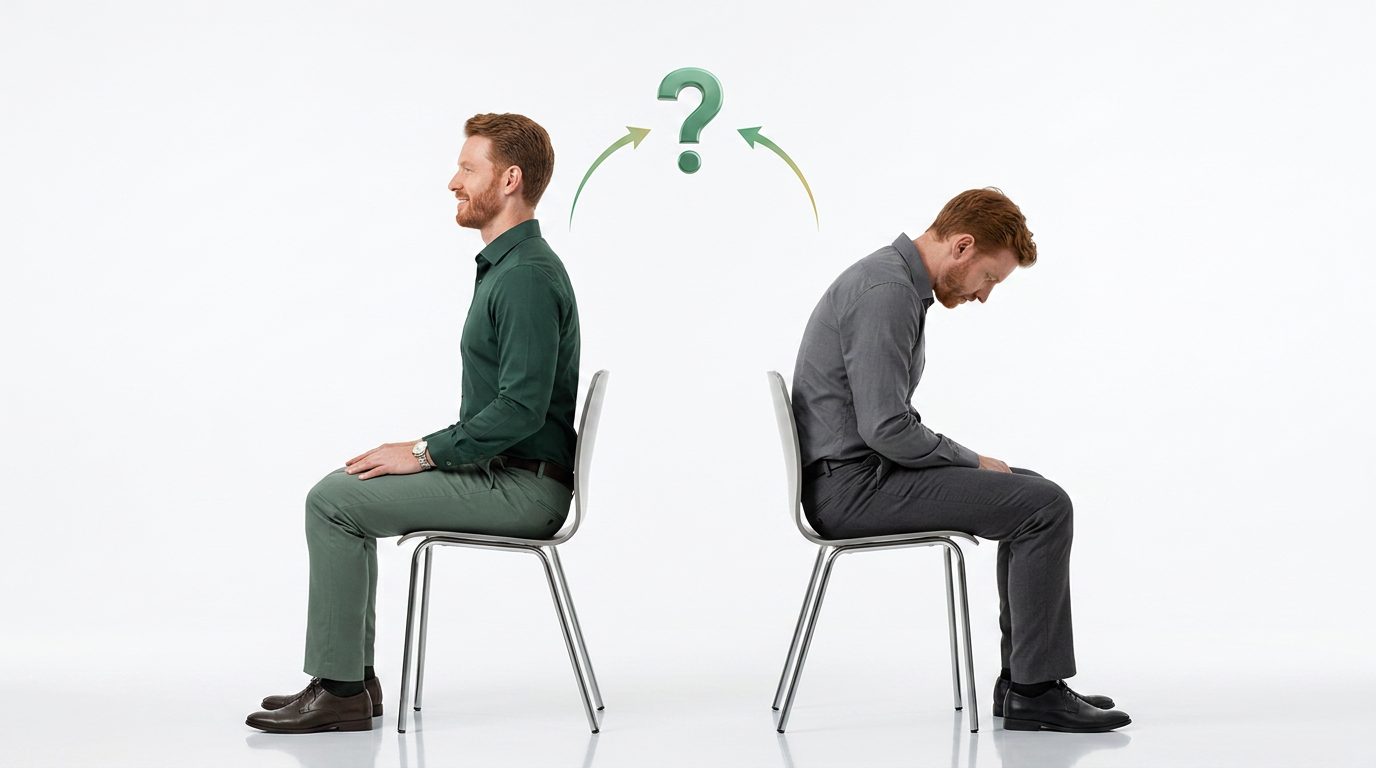
A client came to us recently who had been dealing with pain for close to two years. In that time, they'd seen multiple practitioners, had imaging done, and received more clinical language about their body than most people accumulate in a lifetime - a twisted pelvis, dominant hip flexors, an inhibited glute, a locked ribcage, pronated feet. They arrived at their first session having done significant research, with detailed notes and a clear picture of everything that was "wrong" with them.
Their deepest worry wasn't the pain itself. It was whether their posture was fundamentally broken - and whether the cascade of misalignments they'd been told about could actually shift.
One of the first things we said was this: nearly everyone we see has postural "misalignments." That includes us. It doesn't make you broken, and it doesn't mean those patterns can't change. What it means is that your body has adapted - intelligently, if imperfectly - to the demands placed on it. And that's actually a workable starting point.
That conversation is what prompted this article.
Introduction
"Sit up straight."
If you grew up with a parent, teacher, or coach, you've heard it. And if you work at a desk, you've probably said it to yourself. Posture has been blamed for neck pain, low back pain, headaches, fatigue, and just about every other musculoskeletal complaint — and an entire industry of posture correctors, ergonomic gadgets, and "fix your posture in 30 days" programs has grown around it.
But what does the research actually say?
The honest answer is: posture matters - but not in the way most people think. Here's what the evidence tells us
The Myth of "Perfect Posture"
In 2019, a paper published in the Journal of Orthopaedic & Sports Physical Therapy made waves with its title alone: "Sit Up Straight": Time to Re-evaluate.
The authors - including some of the most cited researchers in musculoskeletal pain science - argued that the long-held belief that a single "correct" posture prevents pain and injury is not well supported by the evidence. The relationship between posture and pain is far more complex than a simple cause-and-effect equation. People with "perfect" posture get back pain. People with notably imperfect posture live pain-free. And the research consistently shows that no single sitting or standing position can be universally labelled as "correct" or "harmful."
The takeaway isn't that posture doesn't matter at all. It's that the obsession with achieving a fixed, ideal alignment may be missing the point entirely.
So Does Posture Actually Cause Pain?
Here's where it gets more nuanced - and more interesting.
Certain postural patterns are associated with pain and dysfunction. The key word is "associated." Correlation isn't causation, and the research suggests these relationships are bidirectional: posture can contribute to pain, but pain also changes posture. The causal arrow rarely points in just one direction.
Forward head posture is one of the most studied patterns. As screens have become ubiquitous and desk work has exploded, so has the prevalence of the "tech neck" position - head forward of the shoulders, chin jutting, upper traps overloaded. A 2025 systematic review found that forward head posture is consistently associated with measurable changes in neck muscle size and strength, with a smaller craniovertebral angle (a measure of how far forward the head has drifted) correlating with weaker, smaller neck muscles (Binaei et al., 2025). A 2024 systematic review and meta-analysis also found cervical musculoskeletal impairments - including reduced neck mobility and altered muscle function - are common in people with tension-type headaches and migraine (Pensri et al., 2025)
Thoracic kyphosis - the exaggerated rounding of the upper back - is similarly linked to reduced balance, lower quality of life, and decreased spinal mobility. It's not just an aesthetic concern; it has functional consequences that compound over time.
Low back pain in office workers is arguably the most well-documented posture-related problem. A 2025 cross-sectional study found significant differences in lumbar-pelvic rhythm between sedentary office workers with and without low back pain - meaning the way the lumbar spine and pelvis coordinate during movement is measurably altered in people who sit for extended periods and experience back pain (Nishimura et al., 2025).
In short: yes, posture is relevant. The problem is that the conversation has been oversimplified into "bad posture = pain" and "fix your posture = fix your pain," when the reality is more layered.
The Real Problem Isn't Your Position - It's Staying There
One of the most important insights from recent research is that sustained, static positioning - regardless of whether it's "good" or "bad" - is problematic. Your spine and surrounding tissues are designed to move and vary load. Holding any position for prolonged periods increases compressive stress on spinal structures, reduces blood flow to muscles, and fatigues the postural stabilizers that keep you upright.
A 2025 cluster randomised controlled trial published in Ergonomics tested what happened when office workers added a sit-stand desk over six months. The intervention group - who increased standing time by at least 30 minutes per day - showed significant reductions in overall musculoskeletal discomfort and post-work fatigue compared to the control group (Silva et al., 2025). The mechanism wasn't necessarily that standing is "better" than sitting - it's that variation in position breaks the cycle of sustained load on any one structure.
This is the core principle the JOSPT authors were pointing toward: the goal isn't to find a perfect posture and hold it. It's to build a body that can tolerate and transition between a variety of positions without pain.
What Actually Works: The Evidence on Fixing Posture
So if perfect static posture isn't the goal, what is? And does exercise actually help?
Yes - but the specifics matter enormously.
A 2023 randomized controlled trial looked at exercise for low back pain in women with sedentary desk jobs. Participants were divided into two groups: one received individualized exercises based on their specific lumbar curve (hyperlordosis vs. hypolordosis), and the other received the same generic exercise program regardless of their spinal profile. After three months, 60% of the individualized group reported complete absence of low back pain, compared to significantly fewer in the generic group. Lumbar lordosis was within normal limits in 97% of the individualized group versus 47% in the generic group (Proskura et al., 2023).
The message is clear: exercise works, but generic exercise is a blunt tool. The same exercises that help someone with excessive lumbar lordosis may be exactly the wrong thing for someone with a flattened lumbar curve.
For kyphosis specifically, a 2023 randomized controlled trial compared Schroth-based three-dimensional exercises against standard postural corrective exercises over eight weeks. Both groups improved significantly - thoracic kyphosis angle, balance, and quality of life all improved compared to a control group that did nothing. But the Schroth-based group showed greater improvements across all measures, including lumbar lordosis angle (Özdemir Görgü & Algun, 2023). Eight weeks of supervised exercise meaningfully changed spinal curvature. That's not nothing.
For forward head posture with neck pain, a 2025 systematic review and meta-analysis found that rehabilitation programs incorporating breathing interventions showed a moderate effect on improving head position (craniovertebral angle), though effects on pain reduction were more limited and the overall evidence certainty was rated as low (Park et al., 2025). This is a good example of the complexity: postural alignment and pain don't always move in lockstep, and improving one doesn't guarantee improving the other.
What This Means for You
Here's the practical takeaway from the research:
Posture is not destiny. Having a forward head or a rounded upper back doesn't mean you're doomed to pain, and it doesn't mean those patterns can't change. The spine is adaptive and responds to training.
But the intervention needs to match the problem. Generic "sit up straight" cues and one-size-fits-all corrective exercise programs have limited evidence behind them. What consistently works is identifying your specific postural pattern - whether that's kyphosis, lordosis, forward head posture, or something else - and addressing it with a targeted, individualized program or lifestyle interventions. Bike for long hours throughout the week? Perhaps changing modalities or bike type could change or alleviate any pain caused by those long hours held in the same posture.
Movement variety beats any single "correct" position. If you sit all day, the most evidence-based thing you can do is interrupt that sitting regularly. Stand up, move, change position. Your spine's greatest enemy isn't slouching - it's sustained, unchanging load.
Pain is not a reliable indicator of posture, and posture is not a reliable indicator of pain. The two are related but not the same. If you have pain, getting to the root of why - which often involves movement assessment, strength testing, and a thorough clinical picture - is far more useful than trying to "fix your posture" in isolation.
The Vital Approach
At Vital Performance Care, we don't believe in handing everyone the same set of corrective exercises and calling it posture rehab.
We use objective movement assessments to understand your movement patterns - where you're restricted, where you're compensating, where the actual deficits are. For clients whose posture is contributing to pain or limiting performance, we build individualized programs based on what we find, not what we assume.
If you're dealing with neck pain, low back pain, or you've just been told you have "bad posture" and want to understand what that actually means for you - we'd love to talk.
References
Slater D, Korakakis V, O'Sullivan P, Nolan D, O'Sullivan K. "Sit Up Straight": Time to Re-evaluate. J Orthop Sports Phys Ther. 2019;49(8):562-564. PMID 31366294
Proskura P, Rutkowska-Kucharska A, Sobera M. Evaluation of the effects of a novel exercise program in the treatment of low back pain in women working in a seated position: A randomized trial. J Back Musculoskelet Rehabil. 2023;36(4):845-859. PMID 36872766
Özdemir Görgü S, Algun ZC. A randomized controlled study of the effect of functional exercises on postural kyphosis: Schroth-based three-dimensional exercises versus postural corrective exercises. Disabil Rehabil. 2023;45(12):1992-2002. PMID 35694970
Park S, Kim K, Kang M. The Effects of Rehabilitation Programs Incorporating Breathing Interventions on Chronic Neck Pain Among Patients with Forward Head Posture: A Systematic Review and Meta-Analysis. Bioengineering (Basel). 2025;12(9):947. PMID 41007191
Silva H, Ramos PGF, Teno SC, Júdice PB. Impact of a 6-month sit-stand desk-based intervention on regional musculoskeletal discomfort and overall post-work fatigue in office workers: a cluster randomised controlled trial. Ergonomics. 2025;68(9):1422-1435. PMID 39404230
Binaei F et al. The Association Between Craniovertebral Angle and Neck Muscle Size Using Ultrasonography: A Systematic Review. Health Sci Rep. 2025;8(5):e70848. PMID 40432699
Pensri C et al. Cervical musculoskeletal impairments in migraine and tension-type headache and relationship to pain related factors: An updated systematic review and meta-analysis. Musculoskelet Sci Pract. 2025;76:103251. PMID 39756244
Nishimura T et al. Differences in Lumbar-Pelvic Rhythm Between Sedentary Office Workers with and Without Low Back Pain: A Cross-Sectional Study. Healthcare (Basel). 2025;13(10). PMID 40427971

More About The Author
Carla Robbins, MSc Exercise Physiology — Co-Founder, Vital Performance Care
Carla holds an Undergraduate Degree in Exercise Physiology from the University of Calgary and a Master’s in Exercise Physiology (2016). She has worked with the Canadian Sport Institute and co-founded Vital Performance Care with Dr. Amy MacKinnon inside Eau Claire Athletic Club in Calgary. Carla specializes in fitness testing, endurance training, and strength and conditioning for everyday and high-performance athletes.