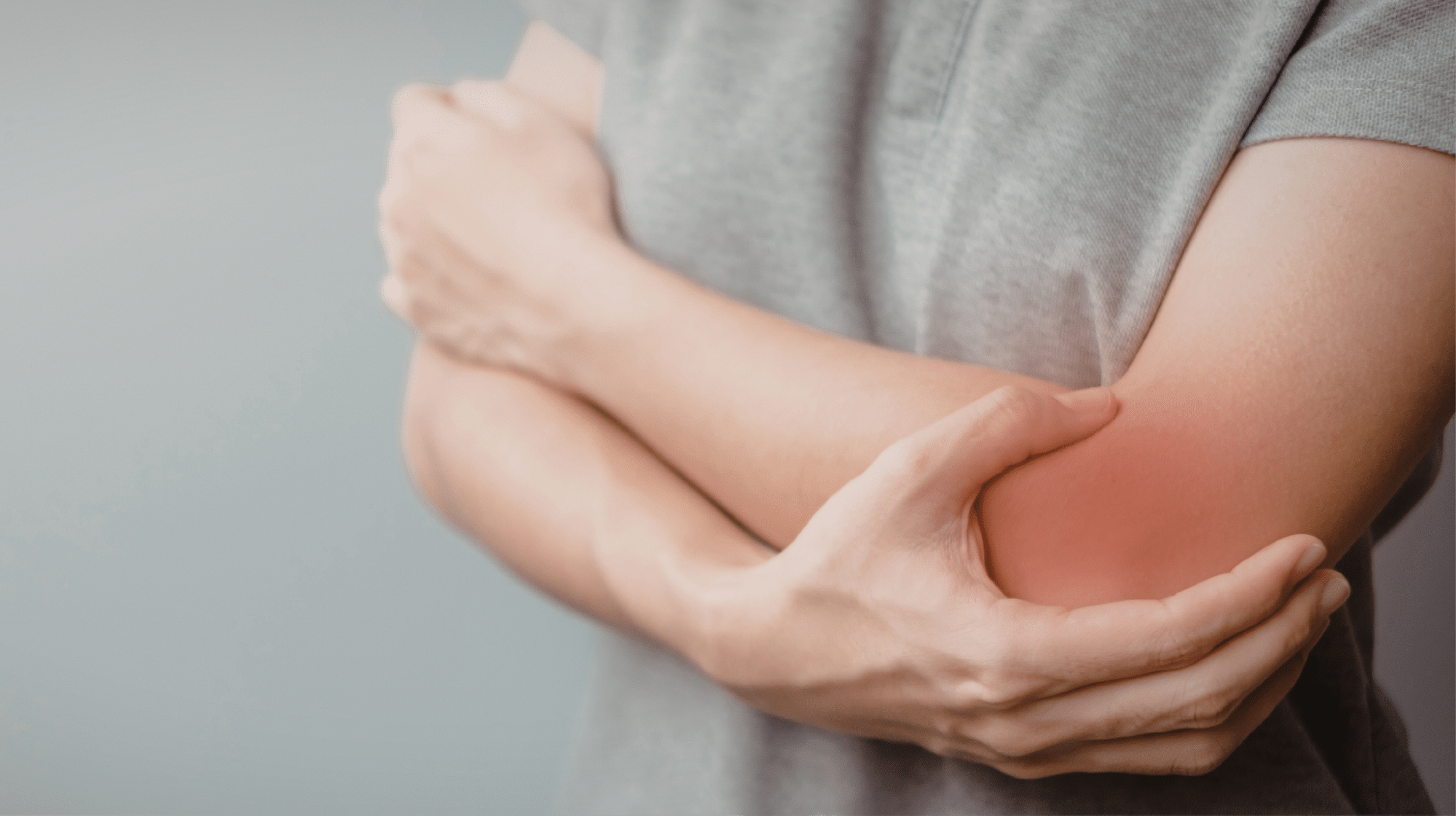
The most common thing we hear when someone comes in with pain on the outside of their elbow? "But I don't even play tennis."
Good — because tennis elbow has almost nothing to do with tennis.
It's a load tolerance problem. And once you understand that, everything about how you manage it starts to make sense.
What Is Tennis Elbow, Really?
Tennis elbow — lateral epicondylitis — refers to pain and tenderness at the lateral epicondyle, the bony bump on the outside of your elbow, where the wrist extensors and finger extensors attach. Like its counterpart golfer's elbow (which affects the inside of the elbow — a distinction my colleague Carla Robbins covers beautifully from an exercise physiology perspective), this is a tendinopathy: a breakdown in the structural integrity of the tendon caused by accumulated stress that outpaces the tissue's ability to recover and adapt.
The typical story involves repetitive wrist extension, gripping, and forearm supination — enough volume, enough intensity, not enough progressive loading or recovery time. The extensor tendons get overloaded. They begin to degrade. Pain follows.
"Tennis elbow" is the sport that put it on the map. In my practice, the actual culprits look a lot more like this:
Gardeners and landscapers doing hours of raking, pruning, and digging
Parents and caregivers who are constantly lifting, carrying, and holding young kids or pets
Gym-goers who push hard on back day — rows, pull-ups, and lat pulldowns put significant demand on the wrist extensors
People who picked up a new racquet sport (pickleball, anyone?), golf, or stand-up paddleboarding without building grip and forearm strength first
Office workers clocking long hours at a keyboard and mouse — especially with poor desk setup
Tradespeople: carpenters, electricians, mechanics doing repetitive tool use
Cyclists, especially mountain bikers gripping over rough terrain
If you grip, extend, or rotate your wrist for a living or a sport, you are a candidate. Tennis is just one of the many ways people get there.
The pain lives on the outside of your elbow — specifically at the lateral epicondyle — and it can radiate down into the forearm. It's the kind of ache that announces itself at inconvenient moments: picking up a coffee cup, turning a doorknob, shaking someone's hand.
Common things people notice:
Tenderness directly on or just below the bony bump on the outside of the elbow
Pain when gripping, lifting, or carrying — often worse with the elbow extended and the palm facing down
Weakness in grip, especially when the arm is straight out in front of you
Discomfort during wrist extension exercises, reverse curls, or any pulling movement
A dull, lingering ache at rest in more irritated cases
Referred pain that travels down the forearm toward the wrist
We'd encourage you not to sit on these symptoms and hope they resolve on their own. As chiropractors at Vital, we don't just do adjustments — we perform detailed orthopaedic assessments, run strength and functional testing, apply hands-on and instrument-assisted therapies, and work directly with our exercise physiology team to build you a progressive plan. If any of this sounds familiar, it's worth getting eyes on it early. You can book a session with one of our chiropractors [HERE].
But Wait — Is It Actually Tennis Elbow?
One of the most important things a chiropractor does at the first visit is rule out what it isn't. Several other conditions can produce lateral elbow pain that mimics tennis elbow, and getting the diagnosis right changes the treatment entirely.
Elbow joint dysfunction or sprain — the elbow joint itself (the humeroradial or humeroulnar joint) can become restricted, inflamed, or hypermobile after a fall, a sudden load, or cumulative wear. This tends to produce pain with end-range extension or flexion, sometimes with a sense of clicking, locking, or instability, rather than the more pinpointed tendon tenderness of lateral epicondylitis.
Radial tunnel syndrome — the radial nerve passes through a narrow tunnel near the lateral elbow, and compression here produces a deep, aching pain that can feel almost identical to tennis elbow — but slightly further down the forearm, and often without the localized epicondyle tenderness. Neurogenic symptoms like tingling, burning, or weakness in specific finger extensors are the tell. This one is frequently missed.
Posterior interosseous nerve entrapment — a branch of the radial nerve that passes between the two heads of the supinator muscle. Entrapment here creates weakness in wrist and finger extension, with pain at the proximal forearm. Because it can coexist with or mimic lateral epicondylitis, careful neurological testing is essential.
Wrist extensor muscle strain or tear — a direct strain of the extensor carpi radialis brevis (ECRB) or longus, often from a sudden eccentric overload rather than the repetitive accumulation pattern typical of tendinopathy. Acute strains tend to present with sharper, more sudden onset and greater focal tenderness along the muscle belly rather than purely at the epicondyle.
Delayed onset muscle soreness (DOMS) — new or ramped-up activity (trying paddleboarding for the first time, an unexpectedly hard back session) can produce forearm and lateral elbow soreness that peaks 24–72 hours later and resolves within a week. True DOMS is bilateral, follows a predictable timeline, and lacks the point tenderness and load-provoked pain pattern of tendinopathy. Many people mistake this for the start of a chronic problem — and some do push through it into one.
Cervical radiculopathy — nerve root compression at C6 or C7 in the neck can refer pain down the arm into the lateral elbow and forearm. It's often accompanied by neck stiffness, shoulder tension, or altered sensation in the hand. The elbow itself may have no tenderness at all. Without proper cervical assessment, these cases get treated locally for months with no result.
Osteoarthritis of the elbow — less common in younger populations, but worth considering in older patients with a history of prior elbow trauma or high-load occupational history. OA tends to present with stiffness on waking, crepitus with movement, and pain that's less load-specific than tendinopathy.
A thorough assessment matters. Getting the right diagnosis on day one saves months of frustration.
How We Diagnose Tennis Elbow
Our chiropractic approach to diagnosing lateral elbow pain combines several layers of assessment — because tenderness on the epicondyle alone doesn't tell the whole story.
Orthopaedic testing is the backbone of the clinical assessment. A few tests we commonly use:
Cozen's test — resisted wrist extension with the elbow extended and forearm pronated. A positive test reproduces lateral epicondyle pain and suggests extensor tendon involvement.
Mill's test — passive full elbow extension with simultaneous wrist flexion and forearm pronation. Stresses the extensor tendons and reproduces symptoms in lateral epicondyliyid.
Maudsley's test — resisted extension of the middle finger, which directly loads the ECRB. Pain at the lateral epicondyle is a positive finding.
Grip strength testing with the elbow at varying angles — reduced grip with the elbow extended compared to flexed is a hallmark of lateral epicondylitis.
Neurological screening tests including the upper limb tension test (ULTT) to differentiate nerve involvement.
Strength and endurance testing adds important objective data. At Vital, we use tools like the VALD Force Frame and Dynamo Plus to measure wrist extensor and grip strength — comparing bilaterally, tracking load tolerance, and benchmarking against age- and gender-matched norms. This is exactly the kind of baseline data that allows us to design a genuinely progressive program rather than just doing a bit of everything and hoping something helps. It also gives us a clear way to track recovery over time.
Functional assessment looks at how you actually move: how you grip, how you pronate and supinate under load, how your elbow and shoulder mechanics interact. We look upstream too — limited shoulder mobility or thoracic restriction can shift load disproportionately onto the elbow during overhead and pulling movements.
Imaging is not always required — in fact, for most straightforward presentations of lateral epicondylitis, it adds little to the clinical picture. Where we might refer for imaging: when the presentation is atypical, when symptoms aren't responding as expected, when we want to rule out bony pathology, partial tendon tearing, or loose bodies within the joint. Diagnostic ultrasound paired with an X-ray is particularly useful for visualizing tendon and joint integrity at the epicondyle. We coordinate with imaging providers and medical colleagues when that pathway is warranted.
How We Treat Tennis Elbow
Here's something worth saying plainly: good chiropractic care for lateral epicondylitis looks very different from what people picture when they think of a chiropractor. We are not just adjusting your neck and sending you home. At Vital, our chiros bring a full clinical toolkit — and for elbow tendinopathy specifically, it means combining hands-on therapy with structured exercise progression.
Soft tissue release addresses the muscle tension and fascial restrictions that contribute to load on the lateral elbow. Manual therapy to the wrist extensors, brachioradialis, and supinator can reduce local sensitization and restore tissue extensibility. We use a combination of techniques: active release, cross-friction, and instrument-assisted soft tissue mobilization (IASTM) along the extensor tendons and the forearm.
Joint mobilization of the elbow and wrist is often an important piece of the puzzle. Restricted radiocapitellar joint mobility — a common finding in lateral elbow pain — alters how force is distributed across the joint and increases tendon strain. Restoring joint mechanics through targeted mobilization changes the load environment at the tendon and can produce rapid improvements in pain and grip.
Dry needling and/or acupuncture is one of the most effective tools we have for lateral epicondylitis, particularly for cases that have become chronic or where local tissue sensitivity is high. We needle the extensor tendons and surrounding musculature to elicit a local twitch response, reduce motor point hypertonicity, and stimulate tissue healing. For cases involving radial nerve involvement, needling along the nerve pathway can be helpful as well. Sometimes we add electrical stimulation to the needles as well depending on how clients are responding to different needling techniques.
Cupping is a useful adjunct for improving circulation, reducing fascial adhesion, and decreasing sensitivity in the extensor compartment of the forearm. We use both static and dynamic cupping (moving cups during active wrist and forearm movements) to get the best mechanical effect.
Shockwave therapy is one of the most evidence-supported interventions for chronic tendinopathy. For lateral epicondylitis cases that have been present for three months or more — or that haven't responded adequately to other conservative care — extracorporeal shockwave therapy (ESWT) delivers mechanical energy directly to the tendon attachment, stimulating neovascularization, collagen remodeling, and a fresh healing response. It can feel uncomfortable during treatment but the results in chronic tendinopathy are well-supported.
Exercise prescription is, ultimately, the most important part of recovery — and this is where our chiropractic care and exercise physiology training overlap most directly. We prescribe exercises in-session and coordinate formally with Carla and the Vital training team to build the full progressive loading program. For lateral epicondylitis, that typically means:
Isometric wrist extension holds as the starting point — sustained contractions that load the tendon without movement, produce an analgesic effect, and set the foundation for the isotonic work that follows
Eccentric wrist extensor curls through full range, progressing grip type from standard to thick grip to pinch — the same progressive grip variation framework that Vital trainers use on the medial side
Reverse curl progressions targeting the wrist extensors and brachioradialis under increasing load
Forearm supination loading — because the supinator shares the lateral compartment and is commonly involved, especially in racquet sport and paddling athletes
Grip strength work across multiple modalities, building the overall capacity of the forearm chain
The collaboration between chiro and training at Vital is not incidental — it's the design. What I assess and treat in the clinic, the Vital training team builds upon progressively. We share notes, align on phase gating, and give patients a coherent program rather than two parallel ones that contradict each other. That's what makes the difference for people who've already tried six months of rest and a generic theraband program with nothing to show for it.
Hand + Wrist Foundations: Coming Later This Year
The lateral elbow is often the visible consequence of a chain where the wrist extensors, grip, and forearm rotators have never been trained in any structured way - just loaded ad hoc through sport or work until something gives. Tennis elbow, like golfer's elbow, is frequently a problem of accumulation without adaptation.
Our training team is developing Hand + Wrist Foundations - a structured program built on the same progressive loading framework as Shoulder Foundations, with phase-gated testing, clear progressions, and specific tracks for pain management, performance, and longevity. It's designed for everyone from office workers and gardeners to climbers, hockey players, and racquet sport athletes who want to build real, durable forearm resilience.
Our entire therapeutic team has been involved in the clinical framework of this program from the beginning - because building grip strength in the right sequence, with the right entry points, is exactly what prevents people from ending up in our office with a year of lateral elbow pain and no clear path forward.
Hand + Wrist Foundations is planned for launch later this year.
If lateral elbow pain keeps returning, more rest rarely solves it. What your tendon needs is the right kind of load, in the right amount, building progressively over time — with the clinical picture properly assessed first.
Our chiropractors at Vital Performance Care will assess what's actually driving your elbow pain, rule out the conditions that mimic it, apply the hands-on and instrument-assisted treatments that create the right healing environment, and coordinate directly with our exercise physiology team to make sure your recovery doesn't stop at "feeling better" — it builds all the way to "actually stronger."
Dr. Amy MacKinnon, Co-Founder of Vital Performance Care
Dr. Amy MacKinnonis the co-owner of Vital Performance Care, Coven Health Collective, and Coalition Health Group. A former varsity soccer athlete turned chiropractor, she works with athletes and individuals across all levels, from grassroots to Olympic and professional sport.
Amy has served as Performance Director for multiple sport organizations and worked internationally with Bobsleigh Canada Skeleton, including at the 2018 PyeongChang Olympic Winter Games. Her work is grounded in community, connection, and bridging therapy and performance to help people move and live better.