
Introduction: The Number That Could Change How You Train
Most people have heard the term VO2max — usually in the context of elite runners, pro cyclists, or Olympic athletes. It sounds clinical. Complicated. Like something only serious competitors need to worry about.
But here's the truth: VO2max testing is one of the most actionable things any active person can do, regardless of your sport, age, or fitness level.
At Vital Performance Care in Calgary, our exercise physiologists use VO2max testing as a cornerstone of performance assessment — not to rank athletes, but to help real people train smarter, recover better, and understand their bodies in a way that generic fitness programs never could.
If you've been training hard but not seeing results — or if you want to stop guessing and start knowing — VO2max testing might be exactly what's been missing.
Want to know your number? BOOK A VO2MAX ASSESSMENT AT VITAL
What Is VO2max — Really?
VO2max stands for maximal oxygen uptake — the maximum rate at which your body can consume oxygen during intense exercise. It's measured in millilitres of oxygen per kilogram of body weight per minute (mL/kg/min).
In simple terms: it's a measure of how efficiently your cardiovascular and muscular systems work together under maximum effort.
Why Does It Matter?
VO2max is widely considered the gold standard measure of cardiorespiratory fitness. Here's why it matters beyond elite sport:
- It predicts long-term health outcomes — higher VO2max is associated with lower risk of cardiovascular disease, type 2 diabetes, and all-cause mortality
- It tells you how you're actually adapting to training — you can train for months without knowing if your cardiorespiratory system is improving. VO2max gives you an objective answer
- It helps personalize your training zones — generic heart rate zones are estimates. VO2max-derived zones are tailored to your physiology
- It reveals performance limiters — if your VO2max is high but your performance is lagging, the bottleneck is elsewhere. This is incredibly useful information
What the Test Actually Involves
At Vital Performance Care, a VO2max test typically involves:
The Protocol
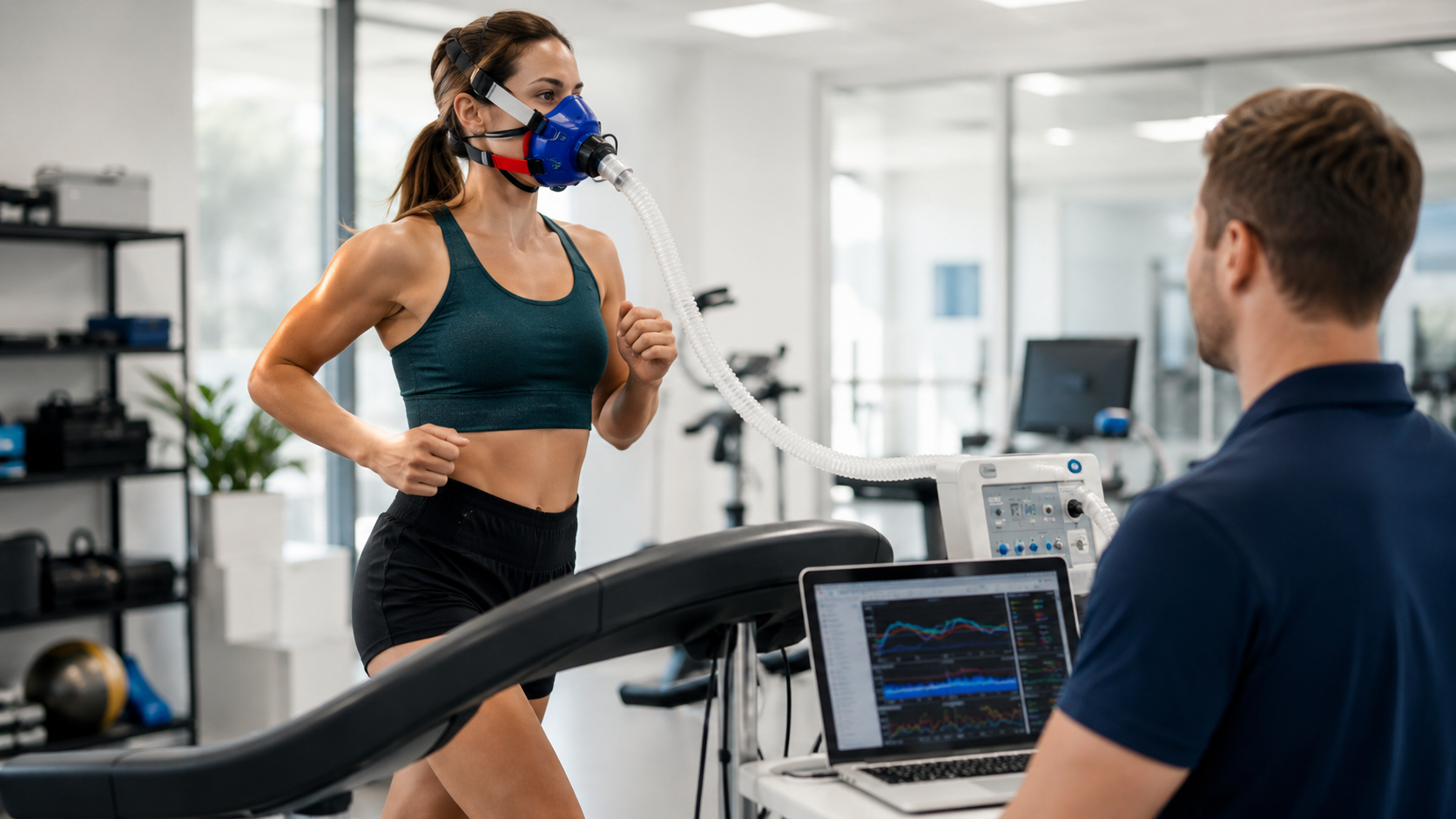
- Equipment fitting: You'll wear a specialized breathing mask connected to a metabolic analyzer. We can do the test on a treadmill or a cycle ergometer (bike).
- Graded exercise protocol: You'll exercise on a treadmill or cycle ergometer, starting at a comfortable intensity and increasing gradually every few minutes
- Data collection: The analyzer tracks your oxygen consumption, carbon dioxide production, ventilation, and heart rate in real time
- Results and interpretation: Your exercise physiologist will walk you through your data — VO2max score, ventilatory thresholds, heart rate response, and training zones
How Long Does It Take?
The exercise protocol itself is typically 10–20 minutes. With warm-up, briefing, and results discussion, plan for 60–75 minutes total. The test is safe for the vast majority of healthy adults.
Who Should Get VO2max Tested?
Runners and Endurance Athletes
If you're training for a 5K, half marathon, marathon, or ultramarathon in Calgary, VO2max testing tells you where your ventilatory thresholds fall — critical for pacing strategy — and whether your aerobic base is the limiting factor.
Anyone Who Has Hit a Wall in Training
You've been consistent. You're logging the hours. But your pace, your lifts, your times — they've plateaued. A VO2max test can reveal whether your aerobic system is the bottleneck, or confirm that it's something else entirely.
People Returning from Injury
After a significant injury or time off, it can be hard to know where you actually are fitness-wise. VO2max testing gives you an honest baseline so your return-to-sport progression is data-driven, not guesswork.
Health-Conscious Adults Over 40
Cardiorespiratory fitness declines with age, but it's highly trainable. Many of our clients in their 40s, 50s, and 60s use VO2max testing as part of a broader longevity strategy — understanding where they stand and tracking their progress over time.
What Your Number Tells You (and What It Doesn't)
|
Age |
Aerobic Fitness |
Male VO₂max (ml/kg/min) |
Female VO₂max (ml/kg/min) |
|
15–19 |
Excellent |
>57.4 |
>49 |
|
Very Good |
52.4–57.3 |
43.7–48.9 |
|
|
Good |
48.8–52.3 |
39.5–43.6 |
|
|
Fair |
43.6–48.7 |
36.8–39.4 |
|
|
Poor |
<43.6 |
<36.8 |
|
|
20–29 |
Excellent |
>55.6 |
>47.2 |
|
Very Good |
50.6–55.5 |
42.0–47.1 |
|
|
Good |
47.2–50.5 |
37.8–41.9 |
|
|
Fair |
41.6–47.1 |
35.0–37.7 |
|
|
Poor |
<41.6 |
<35.0 |
|
|
30–39 |
Excellent |
>48.8 |
>45.4 |
|
Very Good |
45.4–48.7 |
40.1–45.3 |
|
|
Good |
40.1–45.3 |
36.0–40.0 |
|
|
Fair |
33.7–40.0 |
33.0–35.9 |
|
|
Poor |
<33.7 |
<33.0 |
|
|
40–49 |
Excellent |
>47 |
>40 |
|
Very Good |
42.7–46.9 |
35.1–39.9 |
|
|
Good |
35.5–42.6 |
31.9–35.0 |
|
|
Fair |
31.9–35.4 |
27.1–31.8 |
|
|
Poor |
<31.9 |
<27.1 |
|
|
50–59 |
Excellent |
>41.8 |
>36.6 |
|
Very Good |
36.5–41.7 |
34.0–36.5 |
|
|
Good |
30.1–36.4 |
31.0–33.9 |
|
|
Fair |
26.0–30.0 |
24.6–30.9 |
|
|
Poor |
<26.0 |
<24.6 |
|
|
60–69 |
Excellent |
>38.4 |
>35.8 |
|
Very Good |
32.8–38.3 |
32.8–35.7 |
|
|
Good |
28.7–32.7 |
29.6–32.7 |
|
|
Fair |
23.5–28.6 |
23.5–29.5 |
|
|
Poor |
<23.5 |
<23.5 |
Adapted from from Canadian Society for Exercise Physiology (2019). CSEP Physical Activity Training for Health (CSEP-PATH) Resource Manual (2nd ed.). If these differ from your health benefit ratings on other pages of this report, just know that there are slightly different scoring systems.
Note: Norms vary by age. An exercise physiologist will interpret your score relative to your age and goals.
Importantly, VO2max alone doesn't explain everything. Two athletes with identical VO2max scores can have very different performances based on lactate threshold, running economy, strength, and pacing strategy. This is why at Vital, we use VO2max as one piece of a larger performance picture — not the whole story.
How We Use VO2max Data at Vital Performance Care
What sets our approach apart isn't the test itself — it's what we do with the data.
Personalized Training Zones
Your results will map out precise training zones — Zone 1 through Zone 5 — based on your actual physiology, not population averages. This makes every training session purposeful.
Integration with Injury History and Clinical Care
Your exercise physiologist works alongside our physiotherapy and chiropractic team. If you've had a knee injury, Achilles issue, or history of overtraining, your VO2max results inform not just your training plan but how your clinical team supports your tissues through the process.
Longitudinal Tracking
A single test is valuable. Serial testing — every 3–6 months — is transformative. Tracking your VO2max over time tells you whether your training is actually working, and helps us adjust if you're not adapting as expected.
Ready to train with actual data behind you? BOOK WITH OUR TEAM HERE
The Bottom Line
VO2max testing in Calgary isn't reserved for Olympic hopefuls. It's for anyone who wants to understand their body, train with purpose, and make the most of the effort they're putting in.
At Vital Performance Care, our exercise physiologists use VO2max testing as part of a comprehensive approach to performance — one that connects your aerobic capacity data to your clinical care, your training, and your long-term goals.
Whether you're a seasoned runner, a weekend warrior, or simply someone who wants to train smarter as you age, we'd love to help you find your number — and know exactly what to do with it.
|
READY TO FIND OUT WHERE YOU STAND? Book a VO2max assessment with the Vital Performance Care team in Calgary. → BOOK NOW HERE Or call us: (587) 834-2001 | info@vitalperformancecare.com |
References
American College of Sports Medicine. (2022). ACSM's guidelines for exercise testing and prescription (11th ed.). Wolters Kluwer.
Blair, S. N., et al. (1996). Influences of cardiorespiratory fitness and other precursors on cardiovascular disease and all-cause mortality. JAMA, 276(3), 205–210.
Kodama, S., et al. (2009). Cardiorespiratory fitness as a quantitative predictor of all-cause mortality and cardiovascular events. JAMA, 301(19), 2024–2035.
Myers, J., et al. (2002). Exercise capacity and mortality among men referred for exercise testing. New England Journal of Medicine, 346(11), 793–801.