

Introduction: What's Actually Going to Kill You — and What You Can Do About It
Here's a statistic that changes how you think about fitness.
More than 80% of deaths in non-smokers over the age of 50 come down to four categories of disease. Cardiologist and longevity physician Dr. Peter Attia calls them the Four Horsemen of chronic disease: atherosclerotic cardiovascular disease, cancer, neurodegenerative disease (primarily Alzheimer's), and metabolic disease.
These are not random acts of biology. They are largely preventable — or at minimum, dramatically delayable — through one factor more than any other.
That factor is cardiorespiratory fitness. Specifically, your VO2max.
VO2max — your maximal oxygen uptake — is not just a performance metric for elite runners. It is the single strongest predictor of all-cause mortality in the research literature. More predictive than blood pressure. More predictive than cholesterol. More predictive than smoking status.
At Vital Performance Care in Calgary, we use VO2max testing because we believe the people we work with deserve more than generic health advice. They deserve to understand their own physiology — and to use that data to genuinely change their trajectory.
Whether you're a competitive athlete, a health-conscious adult over 40, or someone who simply wants to know where they stand, this is what VO2max testing can tell you — and why it matters more than almost anything else you could measure.
What Is VO2max — Really?
VO2max stands for maximal oxygen uptake — the maximum rate at which your body can consume and utilize oxygen during intense exercise. It's measured in millilitres of oxygen per kilogram of body weight per minute (mL/kg/min).
In physiological terms, it reflects the integrated function of your cardiovascular system (how much blood your heart pumps), your respiratory system (how efficiently you exchange gases), your vascular system (how well your muscles receive oxygen-rich blood), and your muscle cells themselves (how effectively they extract and use oxygen for energy production via mitochondrial oxidative phosphorylation).
Put simply: VO2max is how efficiently your engine runs under maximum demand.
Why VO2max Is the Gold Standard
A 2024 meta-analysis drawing on data from over 20.9 million observations across 199 cohort studies confirmed what the research has been building toward for decades: cardiorespiratory fitness is a strong, consistent, and independent predictor of morbidity and mortality across virtually every major disease category.
The landmark Kodama et al. (2009) JAMA meta-analysis found that each 1-MET increase in cardiorespiratory fitness (roughly 3.5 mL/kg/min of VO2max) was associated with:
- A 13% reduction in all-cause mortality risk
- A 15% reduction in cardiovascular disease risk
When comparing the least fit individuals to the most fit, the hazard ratio for all-cause mortality was 5.04 — meaning the least fit group had five times the mortality risk of the most fit. Moving from the bottom 25% of fitness to just the 50th percentile — not elite fitness, just average — has been associated with roughly a 50% reduction in premature mortality risk.
That is not a marginal gain. That is a fundamental change in life expectancy driven by one trainable variable.
The Four Horsemen: How Your Fitness Affects Each One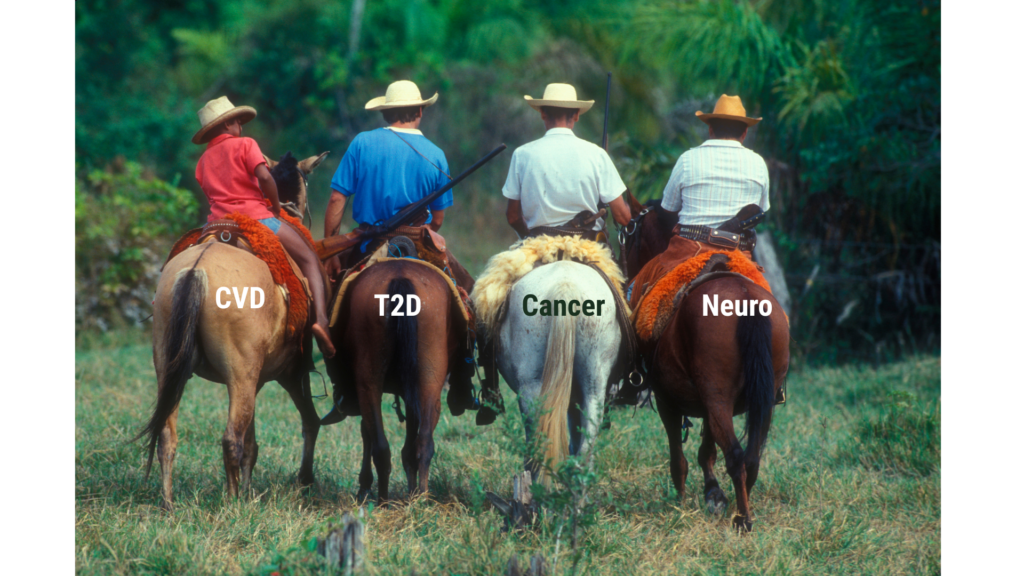
The four categories of disease that account for the majority of deaths in adults over 50 are not independent of your fitness level. For every one of them, higher VO2max and cardiorespiratory fitness is associated with meaningfully lower risk.
Horseman 1: Atherosclerotic Cardiovascular and Cerebrovascular Disease
Cardiovascular disease (heart attack, coronary artery disease, heart failure) and cerebrovascular disease (stroke) account for approximately 19 million deaths globally per year — the largest share of the four horsemen.
The relationship between aerobic fitness and cardiovascular health is the most thoroughly documented link in exercise science. The mechanisms are clear: regular aerobic training reduces resting heart rate, lowers blood pressure, improves cardiac output, reduces arterial stiffness, decreases LDL and triglycerides, and raises HDL.
The Myers et al. (2002) New England Journal of Medicine study found that exercise capacity was the strongest predictor of mortality among men referred for cardiac testing — stronger than hypertension, diabetes, and smoking history. Each 1-MET increment in exercise capacity corresponded to a 12% improvement in survival.
Improving your VO2max is one of the most evidence-based interventions available for reducing cardiovascular risk — full stop.
Horseman 2: Cancer
Cancer kills approximately 10 million people globally per year. Many people assume it is largely outside their control. The data suggests otherwise.
A 2024 state-of-the-art review in GeroScience found that higher cardiorespiratory fitness is consistently associated with reduced cancer risk across multiple tumour types — including breast, endometrial, colon, lung, and pancreatic cancers. Key findings include:
- High cardiorespiratory fitness was associated with a 24% lower risk of breast cancer
- Each 1-MET increase in fitness was associated with a 19% reduction in endometrial cancer risk
- Each 1-MET increase corresponded to an 18% reduction in cancer-specific mortality in cancer patients
- Cancer patients with high fitness had 31–46% lower all-cause mortality than those with low fitness
The mechanisms include improved immune surveillance, reduced systemic inflammation, lower circulating insulin and IGF-1 (which drives tumour growth), healthier hormonal profiles, and reduced visceral adiposity — all of which are sensitive to aerobic fitness levels.
Horseman 3: Neurodegenerative Disease (Alzheimer's and Dementia)
Neurodegenerative disease — particularly Alzheimer's — affects approximately 9 million people globally per year and is the horseman for which Medicine 2.0 has the fewest pharmacological interventions. There is no reliable drug treatment for Alzheimer's. What there is, is exercise.
Research has found that higher VO2max at age 50 correlates with delaying dementia onset by approximately a decade. The mechanisms operate through multiple pathways:
- Aerobic exercise is one of the most powerful stimulators of BDNF — a growth factor for neurons. BDNF promotes neuronal survival, synaptic plasticity, and neurogenesis in the hippocampus, the region most affected by Alzheimer's. BDNF (Brain-Derived Neurotrophic Factor):
- Higher fitness is strongly correlated with myelin content in white matter. Even small improvements in VO2max produce large improvements in myelin — with adults over 40 showing the greatest response. Myelin integrity:
- Higher VO2max is associated with lower systemic inflammation and reduced oxidative stress — two primary drivers of neurodegeneration. Inflammation and oxidative stress:
- Higher fitness is associated with preserved integrity of the locus coeruleus-noradrenergic system, one of the earliest brain regions affected in Alzheimer's progression. Locus coeruleus integrity:
Building and maintaining aerobic fitness from midlife onward is the most effective known strategy for preserving cognitive function and reducing neurodegeneration risk.
Horseman 4: Metabolic Disease
Metabolic disease spans a spectrum from hyperinsulinemia and insulin resistance to non-alcoholic fatty liver disease, type 2 diabetes, and metabolic syndrome. Diabetes alone causes roughly 1.5 million deaths annually — but its broader impact is much larger, because metabolic dysfunction is the horseman that accelerates all three of the others.
Insulin resistance and hyperinsulinemia contribute to atherosclerotic plaque formation, elevate cancer-promoting hormones, and accelerate neuroinflammation. Metabolic dysfunction is increasingly recognized as a driver of what some researchers call 'Type 3 diabetes' — insulin resistance in the brain.
Aerobic fitness is one of the most powerful modulators of metabolic health available. Zone 2 training — sustained low-to-moderate intensity exercise calibrated to your first ventilatory threshold — is particularly effective for improving mitochondrial density and fat oxidation capacity in skeletal muscle. When muscles oxidize fat efficiently, they draw less on glucose, reducing the insulin demand that drives metabolic dysfunction over decades.
Addressing metabolic health through fitness is not just fighting one horseman. It is protecting against all four.
What VO2max Testing Reveals Beyond a Single Number
A VO2max test is not just about a peak oxygen uptake value. A properly conducted metabolic test reveals multiple layers of physiological information that are directly actionable:
- The exercise intensities at which your body shifts from fat-burning to carbohydrate-burning (VT1), and from aerobic to anaerobic energy supply (VT2). These thresholds — not your maximum heart rate — define your true training zones. Ventilatory thresholds (VT1 and VT2):
- VT1 relative to VO2max tells you how developed your aerobic base is — the foundation of endurance performance and metabolic efficiency. Aerobic base capacity:
- Abnormal heart rate responses, ventilatory inefficiency, or early fatigue can all be identified, sometimes flagging issues worth further clinical investigation. Cardiac and ventilatory response to exercise:
- How quickly your heart rate drops following peak exercise is a strong independent predictor of cardiovascular health. Recovery efficiency:
- Zones derived from your own ventilatory thresholds are meaningfully different from population formulas. They make every training session purposeful. Your actual training zones:
What the Test Actually Involves at Vital Performance Care
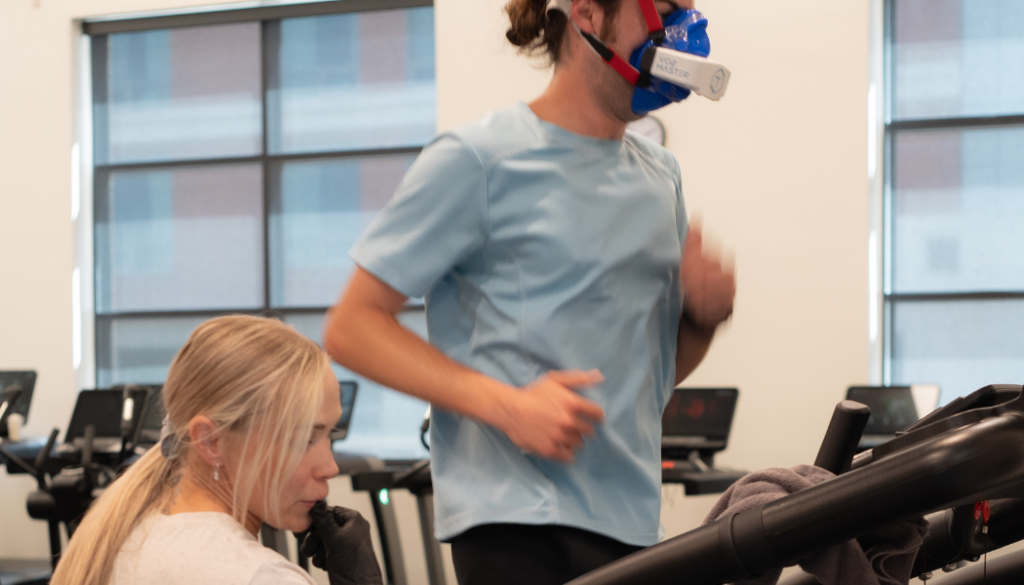
The test is more accessible than people expect.
- Pre-test health screening — review of health history and relevant clinical considerations.
- Equipment fitting — a metabolic mask connected to a calibrated gas analyzer that measures the volume and composition of each breath.
- Graded exercise protocol — treadmill or cycle ergometer, starting easy, increasing every 2–3 minutes over approximately 10–20 minutes.
- Continuous monitoring — heart rate, oxygen consumption, carbon dioxide production, and ventilation measured in real time.
- Maximal or submaximal effort — full VO2max tests push to genuine maximum; submaximal versions estimate thresholds with less exertion where appropriate.
- Results review — your exercise physiologist walks you through VO2max value, VT1 and VT2 thresholds, training zones, and what it all means for your goals.
The exercise protocol is typically 10–20 minutes. Allow 60–90 minutes total for the full appointment including warm-up, briefing, and results consultation.
Who Should Get VO2max Tested?
Active Adults Over 40 Focused on Longevity
The four horsemen become increasingly relevant after 40. VO2max testing gives you a direct measure of where you stand against the most evidence-based predictor of long-term health — and a clear target for improvement. It is one of the most useful investments in preventive health available.
Recreational and Competitive Runners, Cyclists, and Triathletes
If you're training for a 5K, half marathon, marathon, or triathlon in Calgary, VO2max testing tells you whether your aerobic base is the limiting factor, where your ventilatory thresholds fall (critical for race pacing), and what training zones will actually stimulate adaptation rather than just fatigue.
People Who Have Hit a Training Plateau
You've been consistent. The hours are there. But the times aren't improving. A VO2max test can reveal whether your aerobic system is the bottleneck — or redirect your training to where the real ceiling actually is.
People Returning from Injury or Time Off
After significant time off, fitness declines faster than perceived effort suggests. VO2max testing gives you an honest baseline so your return-to-training progression is data-driven, not guesswork.
People with Metabolic Risk Factors
If you have elevated blood sugar, insulin resistance, hypertension, dyslipidaemia, or a family history of cardiovascular or metabolic disease, VO2max testing quantifies your cardiovascular fitness and provides a baseline for tracking the impact of lifestyle changes over time.
What Your Number Means: Benchmarks and Training Zones
VO2max Reference Ranges
|
Category |
Men (mL/kg/min) |
Women (mL/kg/min) |
|
Low |
< 35 |
< 27 |
|
Fair |
35–41 |
27–33 |
|
Good |
42–50 |
34–41 |
|
Excellent |
51–58 |
42–49 |
|
Superior |
> 58 |
> 49 |
Note: Norms vary by age. Your exercise physiologist will interpret your score relative to your age and specific goals.
What a Low VO2max Actually Means
A lower VO2max is not a life sentence. It is a data point — and one that is highly responsive to training. Most sedentary or lightly active adults see meaningful VO2max improvements within 8–12 weeks of structured aerobic training.
The research is also clear: the largest mortality risk reductions come from moving from low fitness to average — not from elite to superhuman. You don't need to be a marathon runner. You need to be consistently, meaningfully active.
Training Zones Based on Your Physiology
Rather than generic heart rate percentages, VO2max testing allows us to define training zones anchored to your actual ventilatory thresholds:
|
Zone |
Physiological Basis |
Primary Purpose |
|
Zone 1 |
Below VT1 |
Active recovery, blood flow |
|
Zone 2 |
At/around VT1 |
Mitochondrial development, fat oxidation, aerobic base |
|
Zone 3 |
VT1 – VT2 |
Lactate tolerance, threshold pace |
|
Zone 4 |
At VT2 |
Threshold capacity, sustained high aerobic output |
|
Zone 5 |
Above VT2 |
VO2max stimulation, anaerobic capacity |
Zone 2 training — steady, conversational-effort aerobic work calibrated to your VT1 — is the foundation of long-term aerobic development and metabolic health. Without knowing where your VT1 actually falls, most people either drift above Zone 2 (accumulating excess fatigue) or stay below any meaningful adaptive threshold.
How We Use VO2max Data at Vital Performance Care
What distinguishes our approach is not the test — it is what happens with the data afterward.
- Your easy days become genuinely easy. Your hard days target the right systems. Your Zone 2 work is calibrated to your actual VT1, not a heart rate formula. Personalized training zones derived from your physiology.
- Your exercise physiologist works alongside our physiotherapy and strength coaching teams. VO2max data informs your training plan and how your clinical care supports your tissues — particularly important for those managing injury history or post-surgical return to sport. Integration with clinical care.
- A single test is informative. Testing every 3–6 months is transformative. Serial VO2max data tells you definitively whether your training is producing adaptation — and allows us to adjust your program when it isn't. Longitudinal tracking.
- Whether you're managing metabolic risk, recovering from injury, training for performance, or simply trying to add quality decades to your life, VO2max data gives your goals a physiological anchor. Connection to your long-term health picture.
Conclusion: The Number That Changes Everything
The research is unambiguous. Cardiorespiratory fitness is the single strongest modifiable predictor of how long you will live and how well you will live. It acts against every one of the four leading causes of death in adults. It is more powerful than most medications we have for the diseases that ultimately kill most people.
And unlike your genetics, your age, or your family history, it is trainable.
At Vital Performance Care in Calgary, our exercise physiologists use VO2max testing as the cornerstone of a genuine, individualized performance and health assessment — not a number on a chart, but the foundation of a plan that is specifically yours. Your thresholds. Your zones. Your trajectory.
You don't have to guess at your fitness. You don't have to follow generic programs and hope for the best. You can know exactly where you stand — and exactly what to do about it.
|
Book Your VO2max Assessment in Calgary 👉 Book a VO2max Test at Vital Performance Care |
References
Attia, P. (2023). Outlive: The science and art of longevity. Harmony Books.
Blair, S. N., Kampert, J. B., Kohl, H. W., et al. (1996). Influences of cardiorespiratory fitness and other precursors on cardiovascular disease and all-cause mortality. JAMA, 276(3), 205–210.
Frontiers in Aging Neuroscience. (2023). Exercise therapy to prevent and treat Alzheimer's disease. Frontiers in Aging Neuroscience, 15, 1243869.
Kodama, S., Saito, K., Tanaka, S., et al. (2009). Cardiorespiratory fitness as a quantitative predictor of all-cause mortality and cardiovascular events in healthy men and women: A meta-analysis. JAMA, 301(19), 2024–2035.
Mandsager, K., Harb, S., Cremer, P., et al. (2018). Association of cardiorespiratory fitness with long-term mortality among adults undergoing exercise treadmill testing. JAMA Network Open, 1(6), e183605.
Myers, J., Prakash, M., Froelicher, V., et al. (2002). Exercise capacity and mortality among men referred for exercise testing. New England Journal of Medicine, 346(11), 793–801.
Schmid, D., & Leitzmann, M. F. (2015). Cardiorespiratory fitness as predictor of cancer mortality: A systematic review and meta-analysis. Annals of Oncology, 26(2), 272–278.
Stamatakis, E., Ahmadi, M. N., Gill, J. M. R., et al. (2022). Association of wearable device-measured vigorous intermittent lifestyle physical activity with mortality. Nature Medicine, 28, 2521–2529.
Warburton, D. E., & Bredin, S. S. (2017). Health benefits of physical activity: A systematic review of current systematic reviews. Current Opinion in Cardiology, 32(5), 541–556.

More About The Author
Carla Robbins, MSc Exercise Physiology — Co-Founder, Vital Performance Care
Carla holds an Undergraduate Degree in Exercise Physiology from the University of Calgary and a Master’s in Exercise Physiology (2016). She has worked with the Canadian Sport Institute and co-founded Vital Performance Care with Dr. Amy MacKinnon inside Eau Claire Athletic Club in Calgary. Carla specializes in fitness testing, endurance training, and strength and conditioning for everyday and high-performance athletes.