
You walk into your GP's office for your annual checkup, and somewhere between the blood pressure cuff and the parking ticket, they slide a piece of paper across the desk. "Your DEXA results came back. You've got osteopenia." You nod, walk out, and by the time you reach the car you're already running the same loop most women run: What does that mean? Is it serious? What am I supposed to do about it?
If you've had this moment, you're in good company — but you're also one of the lucky ones. In Canada, a DEXA scan isn't routinely recommended until age 65 or 70, and most doctors won't issue a requisition before then unless a fragility fracture has already occurred. By the time a scan confirms bone loss, the window to get ahead of it has often already closed. Which is exactly why the years around perimenopause and early post-menopause matter so much — this is the time to act, whether or not a diagnosis has prompted you to.
Roughly one in three women over 50 will experience an osteoporosis-related fracture in their lifetime, and the foundations for that risk are laid much earlier than most of us are told — squarely in the years around perimenopause. In a recent paper our research group published in BMJ Open, we noted that women lose up to 10% of their bone mass around menopause and the decade following (Alexander, Kaluta et al., 2025). That's a meaningful chunk of skeleton disappearing during a window when most of us are barely talking about it.
The good news — and this is the part I want every woman who walks through our doors at Vital Performance Care to hear — is that bone loss in midlife is common, but it isn't inevitable. As an exercise physiologist working in this space, I see what the right training program can do. Below is what I wish every woman in peri- or post-menopause knew about her bones, what the research actually says, and how we approach it clinically.
What Is Bone Density and Why Does It Matter?
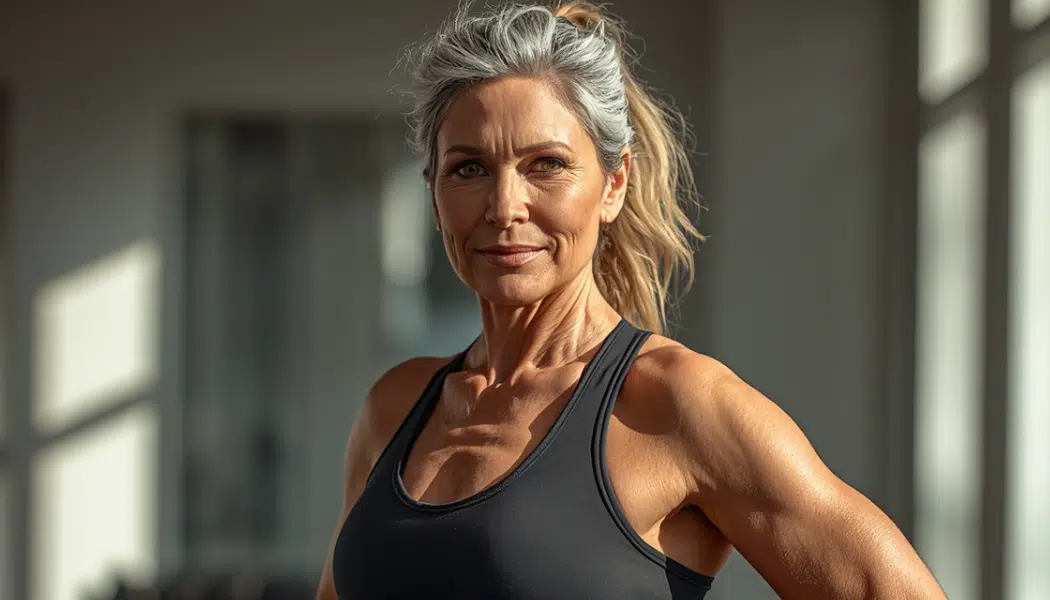
Bone density — more formally, bone mineral density (BMD) — is a measure of how much mineral (mostly calcium) is packed into a given area of bone. Higher density generally means stronger bone. Lower density generally means higher risk of breaking a bone in a fall, a stumble, or even a vigorous cough.
The most common way it's measured is a DEXA scan (dual-energy X-ray absorptiometry). It's quick, low-dose, and painless — you lie on a table for a few minutes while the machine scans your hip and lumbar spine. Your results come back as a T-score, which compares your bone density to that of a healthy young adult. We'll unpack what those numbers mean in a moment.
Here's the catch: in Canada, a DEXA scan isn't routinely recommended until age 65 or 70 — and most GPs won't provide a requisition before then unless you've already had a fragility fracture. That means the majority of women going through perimenopause right now have no idea where their bone density stands. They're navigating the highest-risk window for bone loss without any baseline data to work from.
This is why we can't afford to wait for a diagnosis to start taking bone health seriously. The most powerful thing you can do is begin building and protecting bone density before a scan ever tells you there's a problem.
Why does it matter beyond a number on a page? Because bone strength is what stands between a slip on the ice and a hip fracture that can change the trajectory of your independence. Fractures in older adults are associated with prolonged recovery, reduced mobility, and, in the case of hip fractures, significantly higher mortality in the year following the injury (Compston et al., 2019). Looking after your bones in your 40s and 50s is one of the highest-leverage things you can do for the version of yourself who's 75.
How Much Bone Can You Lose and How Fast?
Here's the part that surprises most of my clients. Bone loss isn't a slow drift that begins in your seventies. The fastest period of bone loss for most women is the late perimenopausal years through the first few years post-menopause. Classic prospective work by Recker and colleagues (2000) found that women in this window can lose roughly 1 to 2% of bone density per year at the lumbar spine, with the trajectory steepening as estrogen declines.
Stack that up over a decade and the math gets uncomfortable: in our 2025 STOP-EM paper, my colleagues and I reported that women lose up to 10% of their bone mass around menopause and the decade that follows (Alexander, Kaluta et al., 2025). The window when most women are juggling careers, ageing parents, and teenagers is exactly the window when their skeletons need the most attention.
Why Menopause Speeds Up Bone Loss
The short version: estrogen is one of the most important regulators of bone metabolism in women, and during the menopausal transition, estrogen drops sharply.
Bone is living tissue. It's constantly being broken down by cells called osteoclasts and rebuilt by cells called osteoblasts — a process called remodelling. In your reproductive years, estrogen acts as a brake on the osteoclasts, keeping the break-down side of that equation in check. When estrogen levels fall during perimenopause, the brake comes off. Bone breakdown accelerates faster than bone formation can keep up, and net bone loss is the result.
This is also why bone loss in midlife is sometimes the first sign of perimenopause a woman finds out about — through a routine DEXA — rather than the hot flashes and sleep changes that grab the headlines. The skeleton is quietly responding to hormonal shifts whether or not you're noticing them anywhere else.
Osteopenia vs Osteoporosis: What Is the Difference?
The difference is mostly about the numbers on your DEXA report — and what they mean for your fracture risk.
DEXA results use a T-score, which compares your bone density to that of a healthy 30-year-old of the same sex. A T-score of -1.0 or higher is considered normal. A T-score between -1.0 and -2.5 is classified as osteopenia, or low bone mass. A T-score of -2.5 or lower meets the diagnostic criterion for osteoporosis.
A few things to know. First, osteopenia isn't a disease — it's a category. It tells you your bone density is lower than the young-adult reference, but not yet in the osteoporosis range. Many women in their 50s land here, and many of them will never progress to osteoporosis if they take the right steps.
Second, your T-score is one piece of the picture, not the whole picture. Fracture risk depends on bone quality and architecture, your fall risk, medications, prior fractures, and family history too. This is part of why our group at the University of Calgary has been looking at bone microarchitecture and bone turnover biomarkers in peri- and early-menopausal women (Alexander, Kaluta et al., 2024) — there's more to bone strength than the headline T-score.
If your T-score is in the osteoporosis range, that's a conversation to have with your GP about whether medication is appropriate alongside exercise. Exercise and pharmacotherapy aren't an either/or — for many women, they work best together.
The Best Exercises for Bone Health
Bone is mechanosensitive. That's a technical way of saying that bone gets stronger when you ask it to do work it isn't used to doing — and stays the same (or gets weaker) when you don't. Bone responds best to mechanical loading that's high-magnitude, applied quickly, and varied (Turner & Robling, 2003).
What that means in plain language: walking is wonderful for many reasons, but walking alone is rarely enough to build bone in postmenopausal women. The exercise that builds bone is, broadly, exercise that's harder than your bones are used to.
Resistance Training
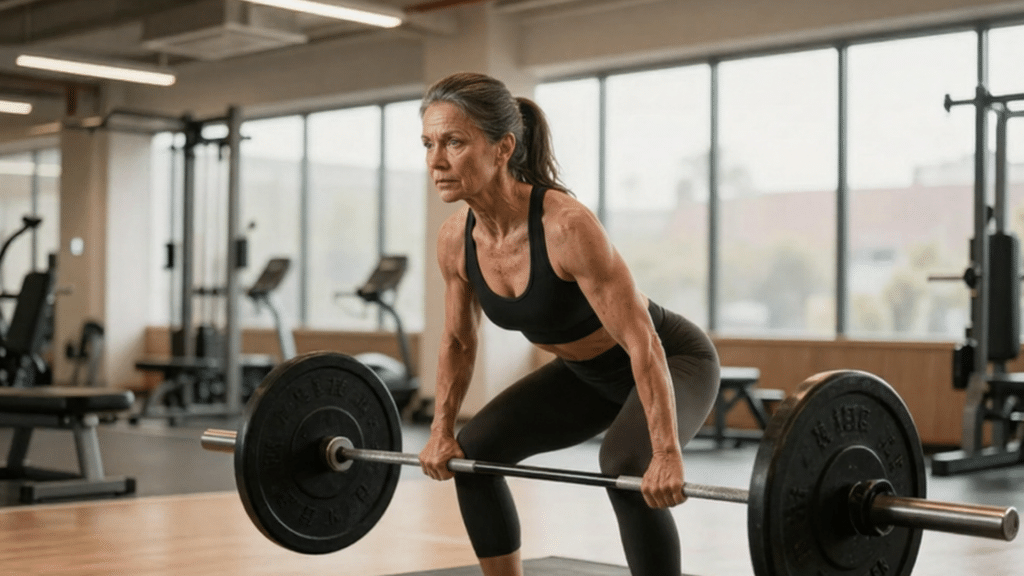
Resistance training is the foundation. Lifting weights — barbells, dumbbells, machines, bands — applied with progressive overload (gradually heavier over time) gives bone the stimulus it needs to add density and stiffness.
For perimenopausal and postmenopausal women specifically, the strongest evidence supports high-intensity resistance and impact training (HiRIT). The landmark LIFTMOR trial (Watson et al., 2018) randomised postmenopausal women with osteopenia or osteoporosis to either HiRIT — heavy compound lifts (deadlift, squat, overhead press) at 80–85% of one-rep-max, plus jumping chin-ups for impact — or a low-intensity home exercise program. After eight months, the HiRIT group saw significantly greater improvements in lumbar spine BMD, femoral neck BMD, height, and functional performance, with an excellent safety profile.
A Cochrane review (Howe et al., 2011) concluded that exercise — particularly progressive resistance training — is effective at slowing bone loss and modestly improving bone density in postmenopausal women. Our group's 2025 systematic review (Whitman, Alexander, Kaluta et al.) zoomed in on the peri- and early-postmenopausal stage specifically — the window where the data has been thinnest — and found that targeted resistance and impact training shows real promise for protecting bone and muscle through the transition.
The headline: lift heavy, lift consistently, progress over time. "Heavy" is relative to you — for someone new to lifting, that starts conservatively and builds with skilled coaching. That's where an exercise physiologist or kinesiologist comes in.
Weight-Bearing and Impact Exercise
Bone also responds to impact — forces transmitted through the skeleton during activities like running, hopping, skipping, or stair sprints. Brisk walking and hiking are weight-bearing but relatively low-impact; they're great for general health and a solid base, but they don't load the skeleton enough on their own to build new bone in most postmenopausal women.
Higher-impact options — jumping, hopping, plyometrics, running — are more potent stimulators. The LIFTMOR protocol, for example, paired heavy lifting with jumping chin-ups specifically to deliver high-magnitude impact at the hip and spine.
That said, impact loading is something we introduce thoughtfully. If you have an established osteoporosis diagnosis, certain vertebral fracture risks, or other contraindications, the type and dose of impact need to be matched carefully to your tolerance. This is exactly the kind of decision an exercise physiologist or kinesiologist earns their keep on.
Balance and Fall Prevention
Strong bones reduce the consequences of a fall. Not falling in the first place is even better.
Roughly half of fractures in older adults are precipitated by a fall, which makes balance and proprioception training a non-negotiable part of any bone-protective program. We work on single-leg standing, dynamic balance drills, reactive balance (catching yourself when nudged), and lower-body strength — particularly through the hips and ankles. Practices like tai chi have a respectable evidence base for improving balance and reducing falls in older adults.
Most of our programs at Vital Performance Care fold balance work into the warm-up or cool-down so it gets done consistently rather than treated as an afterthought.
What an Exercise Physiologist Can Do for You
Reading the research is one thing. Translating it into a program that fits your body, your history, your DEXA results, your other conditions, and your actual life is another.
An accredited exercise physiologist (CEP) is trained to bridge that gap. In a bone-health context, that means interpreting your DEXA in the context of exercise prescription — not as a diagnostic label, but as a starting point for what loading is appropriate and what's contraindicated. It means designing a HiRIT-informed program that progresses safely from wherever you're starting; if you've never picked up a barbell, we don't start at 80% of 1RM on day one — we build technique first, then load. It also means coordinating with your GP, endocrinologist, or specialist, particularly if you're on medication for bone health or being monitored for other conditions. And it means adjusting for everything else going on — joint pain, hot flashes, sleep loss, pelvic floor concerns, prior injuries. Peri- and post-menopausal women aren't "older men in smaller bodies," and your program shouldn't be treated that way.
In our recent survey of nearly 1,000 Canadian women in midlife, my colleagues and I found that 86.5% of women in peri- and post-menopause were interested in a resistance training program targeting bone health, and 71.8% were specifically interested in a HiRIT protocol (Kaluta et al., 2025). The motivation is there. The main barriers women named were time (23.6%) and cost (14.3%) — both very real, and both things we work hard to address through structured, efficient programs that respect what midlife life actually looks like.
Ready to Get Started?
Here's what I want you to take away. Bone loss around menopause is common, but the slope of that decline isn't fixed. The research is clear that the right exercise — done consistently, loaded appropriately, and progressed over time — meaningfully protects bone density, muscle mass, and function during the menopausal transition and beyond.
If you've just had a DEXA come back with a number you didn't love, or you'd simply rather get ahead of bone loss than chase it later, I'd love to help you build a plan. We work with women at every starting point — including those who have never lifted a weight before — and we work alongside your GP and any specialists involved in your care.
Book a Training Consult with Us
References
Alexander CJ, Kaluta L, Whitman PW, Billington EO, Burt LA, Gabel L. (2025). Strength training for osteoporosis prevention during early menopause (STOP-EM): a pilot study protocol for a single centre randomised waitlisted control trial in Canada. BMJ Open, 15(2): e093711.
Alexander CJ, Kaluta L, Whitman PW, et al. (2024). Biomarkers of Bone Turnover and Bone Mineral Density and Microarchitecture in Peri- and Early Menopausal Women. ASBMR 2024 Annual Meeting.
Compston JE, McClung MR, Leslie WD. (2019). Osteoporosis. The Lancet, 393(10169): 364–376.
Howe TE, Shea B, Dawson LJ, Downie F, Murray A. (2011). Exercise for preventing and treating osteoporosis in postmenopausal women. Cochrane Database of Systematic Reviews, (7): CD000333.
Kaluta L, Billington EO, McDonough MH, Burt LA, Gabel L. (2025). Exercise preferences and perceptions of women during the menopausal transition. Applied Physiology, Nutrition, and Metabolism, 50.
Recker R, Lappe J, Davies K, Heaney R. (2000). Characterization of perimenopausal bone loss: a prospective study. Journal of Bone and Mineral Research, 15(10): 1965–1973.
Turner CH, Robling AG. (2003). Designing exercise regimens to increase bone strength. Exercise and Sport Sciences Reviews, 31(1): 45–50.
Watson SL, Weeks BK, Weis LJ, Harding A, Horan SA, Beck BR. (2018). High-intensity resistance and impact training improves bone mineral density and physical function in postmenopausal women with osteopenia and osteoporosis: The LIFTMOR randomized controlled trial. Journal of Bone and Mineral Research, 33(2): 211–220.
Whitman PW, Alexander CJ, Kaluta L, Burt LA, Gabel L. (2025). Does exercising during peri- or early post-menopause prevent bone and muscle loss: A systematic review. Bone.

More About The Author
Leah Kaluta, MKin, Certified Exercise Physiologist
With over two decades of experience in fitness, education, and coaching, Leah Kaluta is a Certified Clinical Exercise Physiologist and strength and conditioning coach dedicated to helping people move better, feel stronger, and live healthier lives.