
Introduction
Tendons are the unsung heroes of movement, bridging the gap between muscle and bone to transfer force and power. Yet, they’re often misunderstood or overlooked until something goes wrong - whether it’s an annoying ache or a serious injury. If you’ve ever wondered why your tendons hurt, what they need to thrive, or how to prevent injuries in the first place, this article has you covered.
Though I’m not a researcher of tendons, I’ve been struggling with my own tendonopathies this year (achilles, hamstring, and glute med/TFL tendon) so I’ve gone down the deep end with my research in 2024. Along with following and reading a ton of research by the tendon great, Keith Barr (lots of references from his in the reference section), I've also been following some newcomer tendon researchers in the space, like Jake Tuura. Along with endless reading, I've been experimenting on myself and our clients with tendon issues, so this article is a quick compilation of everything I've learned in 2024 that I'm bringing into 2025.
From my research and experience, this article outlines most important lessons about tendon health, rehabilitation, and performance I’ve learned so you can understand these VITAL structures better. From proper loading strategies to the role of nutrition, this guide will help you build resilient tendons for life.
After reading, if you still need help, you can contact us.
Top 16 Things You Should Know About Tendons
1. Load Management Is Crucial
Tendons thrive under appropriate, progressive loading. Overloading or underloading disrupts tendon homeostasis, leading to injury or degeneration.
- Inappropriate stress - too much or too little - leads to disorganization and weakening.
- Tendons "get mad" when you do too much, restarting inflammation and delaying the proliferation and remodeling phases (which take weeks to months).
- Tendons "get mad" when you do too little, decreasing collagen synthesis, which is necessary for rebuilding tendons.
- Loading a tendon daily helps reset its circadian rhythm: 12 hours of building, 12 hours of cleaning.
- Low-strain activities: 2+ minute isometric holds, blood flow restriction, medium-rep lifting. Low risk of pain or rupture.
- High-strain activities: jumping, fast change of direction, short/long ground contact times. Higher risk of pain or rupture.
2026 Update: As crucial as load management is, sometimes you will feel worse before you feel better - and this can be profoundly discouraging. In my own proximal hamstring tendinopathy, I was cutting out exercise week by week, doing everything "right," and still declining. In hindsight, I think there is real value in sometimes taking a full 7–10 days completely off - no loading, no tinkering - to let the system reset, refocus your mental energy on other parts of your life, and then carefully re-introduce isometrics as your very first step back. Sometimes the system just needs a hard stop before it can start going the right direction.
2. Metabolic Health Matters
Poor metabolic health (uncontrolled blood sugar or blood pressure) leads to "bad blood," which impairs healing.
- Excess glucose in the system can stiffen tendons by creating cross-links, making them brittle (not the "good" kind of stiffness) and prone to breaking.
- Emerging evidence links poor tendon health to systemic issues like diabetes, obesity, and inflammatory markers.
- Get that blood sugar under control so your tendons will thank you.
2026 Update: On the nutrition side - if your diet already contains enough gelatinous proteins naturally (think chicken cooked with the skin on, broth made from bones, or foods with cartilage), you may not need to supplement with collagen or gelatin + vit C. Food-first is always a reasonable starting point.
3. Nutrition Can't Be Missed
- Collagen-rich foods paired with vitamin C support tendon repair.
- Take 10–20g of collagen or 10–15g of gelatin 30–60 minutes before loading. Include 50–100mg of vitamin C to aid collagen synthesis.
- Daily consumption is recommended, especially during early rehab phases when tendons are progressively reloaded.
(See note in Section 2 above re: food-first approach if your diet is already rich in gelatinous proteins.)
4. Positions That Flare Them Up
Depending on what position you expose your tendon to, it could have a higher likelihood of flare-up or overload:
- Patellar tendon (below kneecap): might not like knees-over-toes positions acutely. Prefer vertical-shin or hinge-dominant movement patterns more.
- Achilles tendon (in the calf): might not like calf-stretching positions acutely, especially if it's a tendinopathy at the attachment by the heel. Start with heels-up isos, and even wear slight heel lifts to relieve the acute pulling.
- Glute med tendon (side of the hip): might not like crossed-leg positions. Start with isos in slight hip abduction or external rotation.
2026 Update: Don't ignore your sleep positions. I learned this the hard way with my proximal hamstring tendinopathy - side-lying eventually became intolerable due to the hip-flexed position. For about a month at the worst point, lying flat on my back was the only position I could sleep in. If you're waking up in more pain after sleeping on your side, it may not be your training that's the problem - it could be your nighttime position compressing or loading the tendon for hours at a time without you realizing it.
5. Tendon Adaptation Is Slow
Tendons adapt much more slowly than muscles, often requiring 12+ weeks for changes in stiffness or strength. Patience is key.
We can load them daily but in small volumes to help "accelerate" healing relative to resting, or only training the tendon like a muscle (2–3 days/week).
2026 Update - Please read this carefully: Tendon adaptation is slow, and you have to let it run its course. Full stop.
Some people start isometrics and feel better within two weeks. Wonderful. But for others - especially those of us who may have a genetic predisposition, or who are dealing with a more reactive tendon - what worked last time might not work this time. Progress might be invisible for weeks. You might plateau. You might feel like you're doing everything right and still feel the same or worse.
This is not a sign that the approach is wrong. It is a sign that tendons are slow, stubborn structures that require patience on a timeline that doesn't care about your training schedule, your race, or your mental health. Trust the process and extend your timeline. If you expect to feel better in 6 weeks, plan for 16.
6. Tendon Pain ≠ Structural Damage
- Healthy tendons have nerves only on the outer sheath.
- Unhealthy tendons develop nerve endings throughout, a sign of maladaptation.
- Tendon pain is often related to sensitivity and load capacity, not structural damage.
- Pain is normal and often reversible with proper training and loading.
2026 Update - a story worth telling: During my hamstring tendinopathy, I explored a hyaluronic acid injection with a sport medicine physician. Before injecting, he used a lidocaine needle under ultrasound guidance to explore the tissue. On ultrasound, we could clearly see a confirmed partial tear in one location and only mild tendinopathy at the attachment site.
Here's what was remarkable: when he poked the confirmed tear, I barely flinched. When he poked the attachment - where the imaging showed only mild tendinopathy - I nearly shot through the roof in pain.
That is the perfect real-world illustration of this point. The area with more structural damage hurt less. The area with less structural damage was exquisitely sensitive. Pain and structural damage are not the same thing, and your pain is not an accurate map of where the problem is.
If you want to go deeper on this concept, I highly recommend the book Explain Pain by David Butler and Lorimer Moseley. It changed how I think about the relationship between tissue and pain entirely. (It can also be found as an audiobook on Spotify).
7. Warm-Ups
- Warm-ups stiffen tendons, reducing strain for a given stress.
- Effective warm-ups: harder activities like plyometrics or running.
- Ineffective warm-ups: easy activities like stretching or calf raises.
- For injured tendons, avoid fast loading during acute flare-ups. Opt for isometric exercises instead with long holds (2+ minutes).
8. Eccentric and Isometric Training Are Beneficial
- Eccentric exercises (e.g., slow lowering movements) promote tendon remodeling.
- Isometrics reduce pain while maintaining tendon load capacity during flare-ups. They may also remove the stress shielding effect that happens when the healthy part of a tendon shields the unhealthy part from load - a maladaptation worth addressing.
- Long and heavy loading (e.g., 8+ second holds) helps squeeze water out of tendons, restoring balance.
9. Blood Flow and Tendon Healing
- Tendons are poorly vascularized, which slows healing.
- Mechanical loading enhances local circulation.
- Blood flow restriction (BFR) is effective in early rehab phases, keeping pain and rupture risk low.
10. Anatomy of Tendons - and Why Loading Variety Matters
- The Achilles tendon spirals as it attaches to the heel. Training ankle rotation movements (e.g., pronation/supination, inversion/eversion) helps load fibres oriented in different directions. This spiral structure likely applies to other tendons as well.
- In general: tendons benefit from being loaded in various ways. Variety is good for long-term adaptation and resilience.
2026 Update: However - when the tendon is in an acute, reactive phase, resist the urge to experiment with too many variations. Keep it simple and consistent so you can actually monitor your progress. If you're doing five different iso variations on different days, you won't know which one is helping or hurting. In the acute phase, less variation with more consistency gives you cleaner signal.
11. Tendon Rehabilitation Requires Specificity
- Rehab must target the affected tendon's specific loading demands (e.g., running, cutting, lifting).
- General strengthening is a good starting point but isn't enough for complete rehab.
- Eventually, you want to progress to plyometrics. Check out our YouTube channel and search for "Tier" to view our public library of plyometric progressions.
12. Age and Tendon Degeneration
- Aging leads to changes in tendon stiffness and composition, increasing injury risk.
- Strength and power training help mitigate these effects.
13. Antibiotic Use
- Fluoroquinolone antibiotics affect tendons negatively by disrupting collagen fibrils, increasing the risk of rupture and tendinitis.
- If you have a recent history of tendon tears or tendinopathies, check your history of antibiotic use - this class of antibiotic is worth flagging with your doctor.
14. Programming for Tendon Loading
Acute Phase (Painful Tendon):
Start with isometric loading with long rests: 2–5 sets of 30-second holds, with 2-minute rests. Daily is okay if pain stays below 3/10 during and after.
Phase 2 (Heavy and Slow):
Add heavy and slow loading. Progress isometrics to harder or weight-bearing variations. Include heavy strength training for relevant muscle groups but avoid movements that "stretch" or "flare" the tendon.
Phase 3 (Plyometrics):
Introduce plyometrics while maintaining heavy strength training. Ensure no increase in pain after sessions or the following day.
Note: both strength (low rep/high load) AND capacity (higher rep/endurance) are eventually important. Doing low rep/high load in the morning and higher rep/capacity work in the evening tends to work well for tendon loading across a day.
15. Why Tendons Tear
- Overload: High forces like sprinting, or a vulnerable joint being loaded suddenly (e.g., a tackle in football).
- Tendinopathy: A pre-existing tendon problem significantly increases tear risk. You can confirm tendinopathy with diagnostic ultrasound.
- Genetic condition: Certain genetic conditions predispose people to tendon tears. Personal note: after years of recurrent tendinopathies across multiple sites at modest training volumes, my physiotherapist and I believe I likely have a genetic predisposition. If this sounds like your story - tendinopathies that seem disproportionate to your training load and keep recurring - it's worth having that conversation with your practitioner.
- Age and sex: Males above 25 and those of white ethnicity are at higher statistical risk for tendon tears.
16. Cortisone Shots
There is no good evidence that cortisone injections help tendons - and plenty of clinical experience suggesting they make things worse, particularly with repeated use.
2026 Update - please read this before you consider cortisone: I've been hearing more stories of practitioners treating tendinopathies without ever directly and progressively loading the affected tendon. One example: a client with a confirmed proximal biceps tendinopathy whose physio spent the entire course of treatment on shoulder rotators, scapular mechanics, and surrounding structures - but never directly loaded the bicep progressively. When the pain persisted, the recommendation was cortisone.
If you have a confirmed tendinopathy, load the tendon directly, progressively, and with patience before you ever consider cortisone. Start with isometrics, advance through heavy-slow loading, and give it the 12–16+ weeks that tendon adaptation actually requires. Cortisone may have a narrow role in very specific circumstances, but it should never be the first, second, or third line of treatment when a structured loading program hasn't been properly tried.
Things Might Get Worse Before They Get Better
I want to add this section because no one told me this, and it was one of the most disorienting experiences of my rehab.
In the weeks following the onset of my worst proximal hamstring tendinopathy, I was doing everything I had learned to be right - reducing load, monitoring pain, being careful. And yet, week by week, I was getting worse. I kept having to cut things out. Here's the full progression of what I removed, in order:
First to go:
RDLs and single-leg RDLs, seated hamstring curl machine, Nordic hamstring curls on the GHR, back extensions on the GHR, back extension isos on the GHR.
When that wasn't enough:
Running, squatting, hip thruster machine, 45-degree back extension machine isos, hiking, elevated hamstring isos, reverse hypers.
When that still wasn't enough:
Walking the dog (anything beyond 2 × 20 minutes was too much), sitting upright, sitting on hard surfaces, sitting at all (I switched to kneeling), and eventually sleeping on my side - any hip flexion was intolerable.
Passive therapies I also had to stop:
Dry needling and active release on the hamstring or surrounding structures caused flare-ups. Massage anywhere near the hip made things worse. I eventually stopped all hands-on therapies and focused only on getting advice on next steps.
This spiral was deeply discouraging. When you cut out everything and still feel worse, it's hard to believe that things will turn around. But they do - and here's what helped me understand what was happening:
The tendon was in a highly reactive, sensitized state. Every input - compressive load from sitting, sustained stretch from side-lying, even the cumulative effect of passive therapy - was too much stimulation for a system that had no bandwidth left.
The solution was not to keep cutting. It was to reset. Full rest for 7–10 days. No loading, no therapy, no monitoring, no testing. Just life. And then, when things had quieted down, carefully reintroducing long-duration isometrics in a position that avoided compression of the tendon against the ischial tuberosity - in my case, standing or prone.
If you're in a spiral like this - if every week you're removing more and things are still getting worse - here is my recommendation:
- Stop everything for 7–10 days. Give the system a hard reset.
- Reassess with your physio after that window.
- Reintroduce isometrics first, in a position that avoids compressive load on the tendon.
- Do not rush. Tendon adaptation is slow (see Section 5), and patience is not optional.
You are not broken. The tendon is just having a very bad time - and it needs a break before it can start adapting again.
Pain Scale
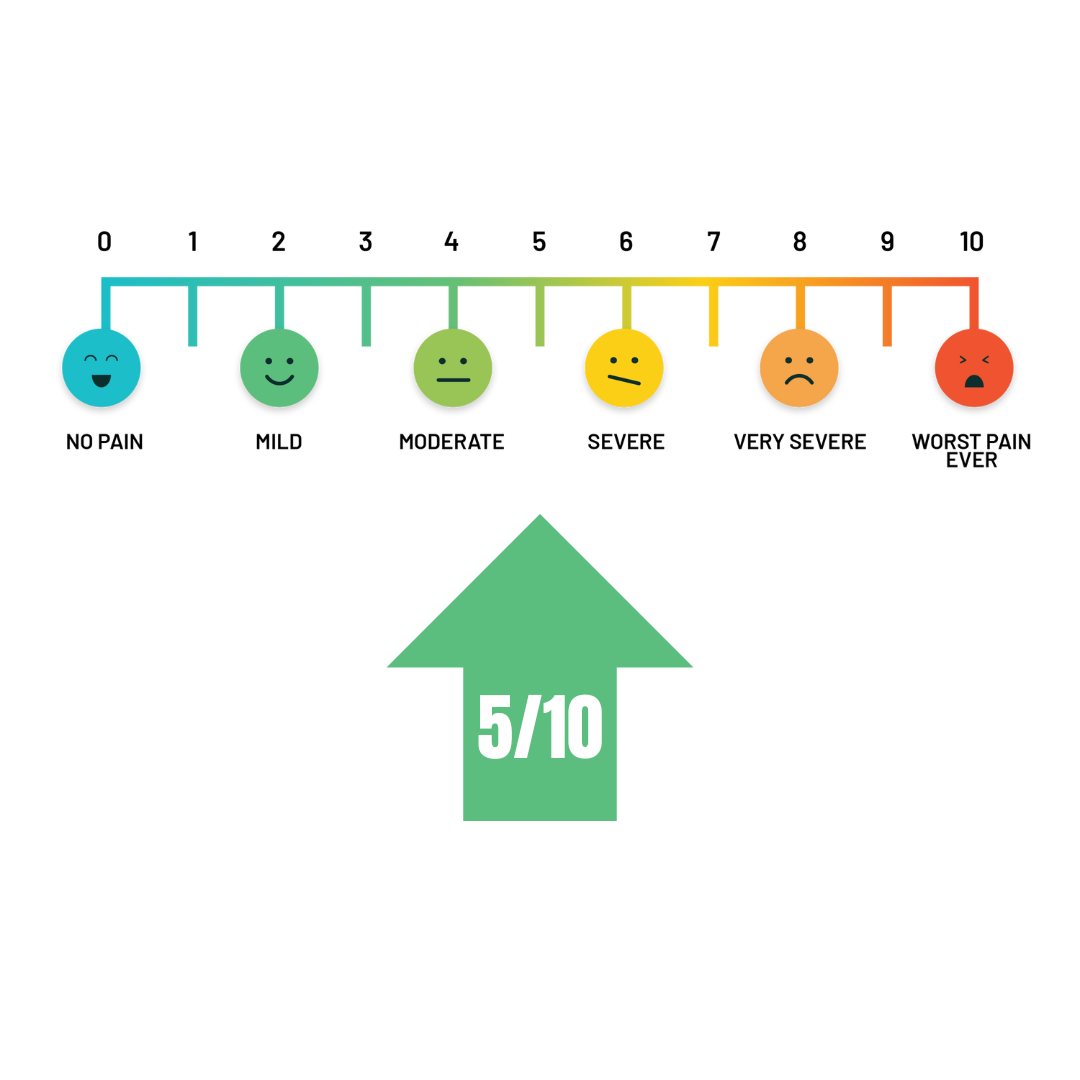
Use this scale to modulate how much pain you should feel while loading the tendon - aim for around a 3–5/10 or less - and keep the pain at the same level as the morning prior, or less. If you wake up with more tendon pain than the day before, decrease the number of sets, reps, or intensity of the exercises (load, force of the isometric push, etc.).
Conclusion
Tendon rehab is never linear. Mini setbacks are expected - and now I'd add: sometimes major setbacks happen even when you're doing everything right.
Understanding and caring for your tendons is more than just avoiding pain. It's about building a foundation for long-term movement and performance. Tendons thrive on the right balance of loading, nutrition, patience, and care. Whether you're recovering from injury, looking to boost your performance, or staying active as you age, these principles will serve you.
After this latest chapter, I've added one more thing to that list: self-compassion. Some of us have tendons that are harder to manage than others. That's not a failure of effort or discipline - it's biology. Work with your body, not against it.
Still unsure where to start? Reach out for personalized advice or explore our programs.

More About The Author
Dr. Amy Mackinnon Chiropractor + Co-owner
- Contemporary Medical Acupuncture
- On point Therapeutic Dry Needling
- Active Release
- Athletic Taping
- Rock Tape
- Graston/Instrument Assisted Soft Tissue Therapy
- Functional Range Conditioning (FRC)
- Complete Concussion Management Training for Healthcare Professionals (CCMI)
- Athletic Movement Assessment – Lower Body (AMA)
- Corrective and Performance Rehabilitation
- Sports Sideline Medical Coverage and Therapy
References
Baar, K. (2019). Stress relaxation and targeted nutrition to treat patellar tendinopathy. International Journal of Sport Nutrition and Exercise Metabolism, 29(4), 453–457. https://doi.org/10.1123/ijsnem.2018-0231
Baar, K. (2006). Training for endurance and strength: Lessons from cell signaling. Medicine and Science in Sports and Exercise, 38(11), 1939–1944. https://doi.org/10.1249/01.mss.0000233799.62153.19
Baar, K. (2017). Minimizing Injury and Maximizing Return to Play: Lessons from Engineered Ligaments. In Sports Medicine (Vol. 47, pp. 5–11). Springer International Publishing. https://doi.org/10.1007/s40279-017-0719-x
Baxter, J. R., Corrigan, P., Hullfish, T. J., O’Rourke, P., & Silbernagel, K. (2021). Exercise Progression to Incrementally Load the Achilles Tendon. Medicine & Science in Sports & Exercise, 53(1), 124–130. https://doi.org/10.1249/MSS.0000000000002459
Butler, D., & Moseley, G. L. (2013). Explain Pain (2nd ed.). Noigroup Publications.
Finni, T., & Vanwanseele, B. (2023). Towards modern understanding of the Achilles tendon properties in human movement research. In Journal of Biomechanics (Vol. 152, pp. 1–13). Elsevier Ltd. https://doi.org/10.1016/j.jbiomech.2023.111583
Fletcher, J. R., Esau, S. P., & MacIntosh, B. R. (2010). Changes in tendon stiffness and running economy in highly trained distance runners. European Journal of Applied Physiology, 110(5), 1037–1046. https://doi.org/10.1007/s00421-010-1582-8
Järvinen, T. A. H., Kannus, P., Paavola, M., Järvinen, T. L. N., Józsa, L., & Järvinen, M. (2001). Achilles tendon injuries. In Current Opinion in Rheumatology (Vol. 13, Issue 2, pp. 150–155). https://doi.org/10.1097/00002281-200103000-00009
Kongsgaard, M., Qvortrup, K., Larsen, J., Aagaard, P., Doessing, S., Hansen, P., Kjaer, M., & Magnusson, S. P. (2010). Fibril Morphology and Tendon Mechanical Properties in Patellar Tendinopathy. American Journal of Sports Medicine. https://doi.org/10.1177/0363546509350915
Lis, D. M., Jordan, M., Lipuma, T., Smith, T., Schaal, K., & Baar, K. (2022). Collagen and Vitamin C Supplementation Increases Lower Limb Rate of Force Development. International Journal of Sport Nutrition and Exercise Metabolism, 32(2), 65–73. https://doi.org/10.1123/ijsnem.2020-0313
Narici, M. v., & Maganaris, C. N. (2007). Plasticity of the muscle-tendon complex with disuse and aging. In Exercise and Sport Sciences Reviews (Vol. 35, Issue 3, pp. 126–134). https://doi.org/10.1097/jes.0b013e3180a030ec
Paxton, J. Z., & Baar, K. (2007). Tendon mechanics: The argument heats up. In Journal of Applied Physiology (Vol. 103, Issue 2, pp. 423–424). https://doi.org/10.1152/japplphysiol.00426.2007
Rees, J. D., Stride, M., & Scott, A. (2014). Tendons - Time to revisit inflammation. British Journal of Sports Medicine, 48(21), 1553–1557. https://doi.org/10.1136/bjsports-2012-091957
Ross, R. K., Kinlaw, A. C., Herzog, M. M., Funk, M. J., & Gerber, J. S. (n.d.). Fluoroquinolone Antibiotics and Tendon Injury in Adolescents. www.firstdatabank.com
Shaw, G., Lee-Barthel, A., Ross, M. L. R., Wang, B., & Baar, K. (2017). Vitamin C-enriched gelatin supplementation before intermittent activity augments collagen synthesis. American Journal of Clinical Nutrition, 105(1), 136–143. https://doi.org/10.3945/ajcn.116.138594
Snedeker, J. G., & Foolen, J. (2017). Tendon injury and repair – A perspective on the basic mechanisms of tendon disease and future clinical therapy. In Acta Biomaterialia (Vol. 63, pp. 18–36). Acta Materialia Inc. https://doi.org/10.1016/j.actbio.2017.08.032
Starbuck, C., Bramah, C., Herrington, L., & Jones, R. (2021). The effect of speed on Achilles tendon forces and patellofemoral joint stresses in high performing endurance runners. Scandinavian Journal of Medicine & Science in Sports. https://doi.org/10.1111/sms.13972
Thomopoulos, S., Parks, W. C., Rifkin, D. B., & Derwin, K. A. (2015). Mechanisms of tendon injury and repair. Journal of Orthopaedic Research, 33(6), 832–839. https://doi.org/10.1002/jor.22806
Tuura, J. (2026). The Tendon Book.
Werd, M. B. (2007). Achilles tendon sports injuries: A review of classification and treatment. Journal of the American Podiatric Medical Association. https://doi.org/10.7547/0970037
Yamamoto, N., Ohno, K., Mayashi, K., Kuriyama, H., Yasuda, K., & Kaneda, K. (1993). Effects of Stress Shielding on the Mechanical Properties of Rabbit Patellar Tendon. https://biomechanical.asmedigitalcollection.asme.org
Xergia, S. A., Tsarbou, C., Liveris, N. I., Hadjithoma, Μ., & Tzanetakou, I. P. (2023). Risk factors for Achilles tendon rupture: an updated systematic review. In Physician and Sportsmedicine (Vol. 51, Issue 6, pp. 506–516). Taylor and Francis Ltd. https://doi.org/10.1080/00913847.2022.2085505