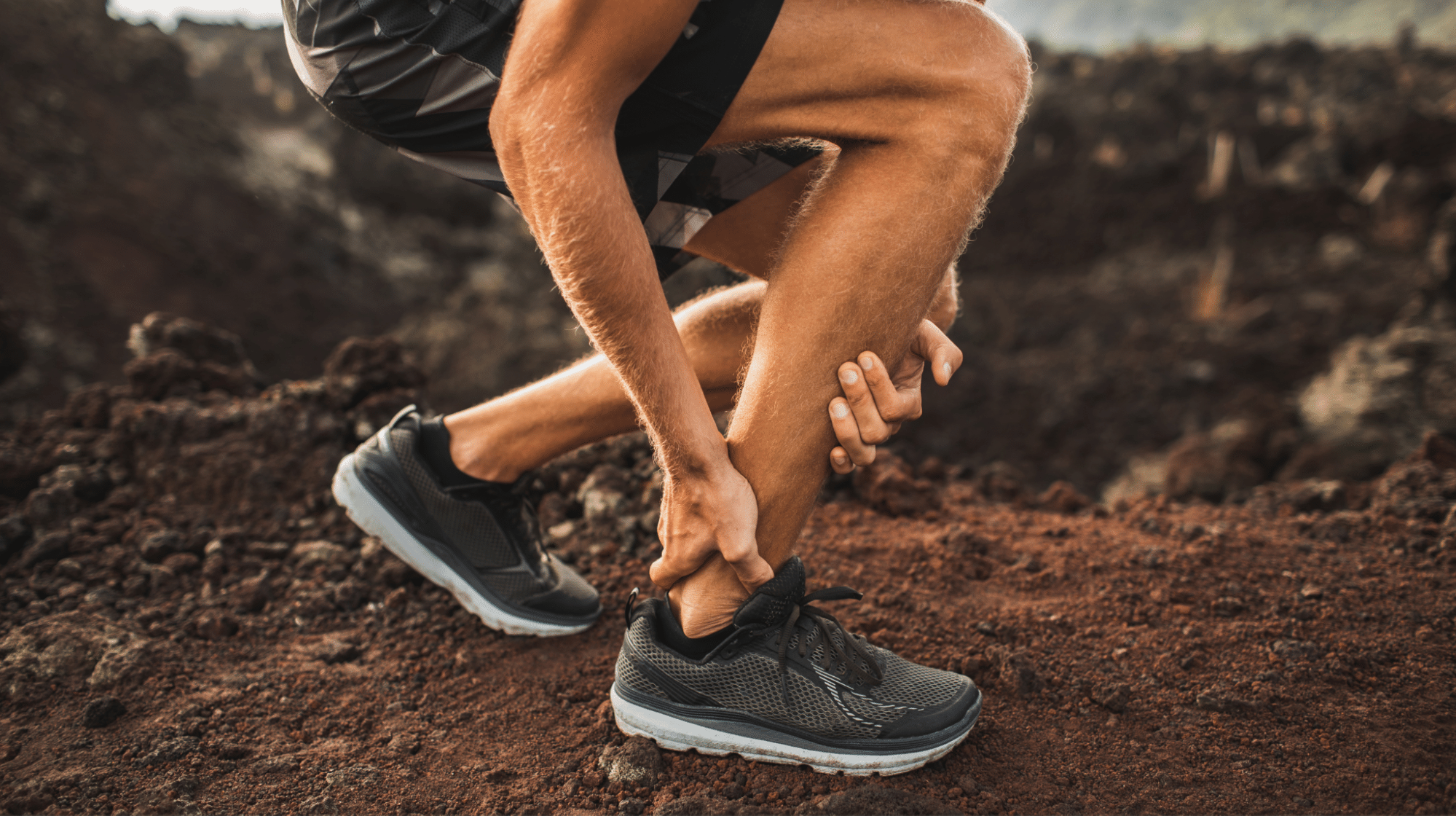
Have you tried to help your ongoing Achilles pain but found that things aren’t improving? You’re not alone. Achilles pain is one of the most common — and most frustrating — injuries we see in active people, and it’s often the one that lingers the longest.
This blog explores the top reasons why your Achilles pain might not be getting better, the underlying factors that may have set you up for it in the first place, and what the research says about how to actually resolve it for the long term.
If you’d rather skip ahead to solutions, you can also try 3 days of our Foot Foundations Program for free and get started right away.
Why Do I Have Achilles Pain?
Tendonitis, tendinosis, and tendinopathy are the terms most commonly used to describe Achilles pain, and together they account for the majority of overuse injuries in and around the Achilles tendon (Järvinen et al., 2001). While heel pain is another common complaint in the ankle region, that’s most often caused by plantar fasciitis (Rosenbaum et al., 2014) — a different condition entirely. For the purpose of this article, we’re focusing specifically on pain over and around the Achilles tendon itself.
So what’s actually going on inside the tendon? Tendinopathy is a broad umbrella term for painful conditions occurring in and around tendons, usually in response to overuse. Here’s the important part: recent research suggests that in many cases, there’s actually little to no inflammation present. That means the old “-itis” label (which implies inflammation) often doesn’t tell the full story — and it also means that anti-inflammatory treatments like ibuprofen may not be targeting the real problem.
If there’s no inflammation driving the pain, then what do you do? Many people have already tried the usual route: they’ve rested, they’ve seen physiotherapists or doctors, and they’ve been given treatments that didn’t quite stick. The most common approaches tend to be passive in nature, things like:
- Rest, ice, compression, and elevation (the classic RICE protocol)
- Stretching, massage, and soft tissue release around the area
- Anti-inflammatory medications or painkillers
- Orthotics, taping, or supportive footwear
- Cortisone injections
These strategies aren’t necessarily wrong — they can certainly help manage symptoms in the short term. But the fundamental issue is that they’re all too static. They don’t require any active input from your body. There’s no demand placed on the tendon, no signal sent from the brain telling the tissue to adapt and get stronger. And if the tendon doesn’t receive that signal, it has no reason to change.
Are Some People More Likely to Get Achilles Pain?
Before we get into solutions, it’s worth understanding what might have set you up for this injury in the first place — because there are certain risk factors that can make Achilles pain more likely, some of which are within your control and some of which aren’t.
Common risk factors for developing Achilles tendinopathy include:
- Chronic disease such as diabetes, or obesity (a BMI over 30 kg/m²)
- Increased tendon thickness
- Wearing rigid insoles or overly stiff shoes
- Genetics — particularly if you have a gene for abnormal collagen production
- Weakness in the muscles of the hip, knee, and ankle
- Poor proprioception, or reduced awareness of your body’s position in space (Martin et al., 2018)
On top of these, there are biomechanical factors that many people don’t even realize could be contributing to their pain:
- Heel striking when you walk or run
- Poor running or walking form that causes too much or too little pronation
- Excessive pronation — sometimes caused by knee valgus (collapsing inward) or flat feet
- Too little pronation — often from stiff, immobile feet or restrictions higher up the chain
- Decreased strength in the foot, ankle, or knee, which causes excessive stress to be concentrated on one area during movement
Now, who does Achilles tendinopathy tend to affect? The majority of people dealing with this condition are active individuals involved in recreational or competitive sports. Estimates of the annual incidence in runners range between 7% and 9%, though it’s not exclusive to athletes — cases have been reported in sedentary people as well. While runners tend to be the most commonly affected group, Achilles problems have been reported across a wide variety of sports, particularly during heavy training phases or in the lead-up to competition.
The risk tends to increase with age, with the average age of those affected falling between 30 and 50 years. And while sex doesn’t appear to play a role in overall risk, research suggests that males may be affected to a greater extent than females (Martin et al., 2018).
If this is beginning to sound like you — the runner or athlete, aged 30 to 50, actively training and wanting to perform — then the question becomes: what can you actually do differently to help resolve the ongoing pain?
How Can I Help My Achilles Pain?
When it comes to managing Achilles pain, the options generally fall into two categories: passive solutions and active solutions.
Passive solutions are what most people try first. They’re perceived as fast and easy, though they can end up being costly over time — both financially and in terms of delayed recovery. These include things like using a heel lift or heel cup, wearing a brace or night splint, foam rolling the calf, and getting regular physiotherapy or massage sessions.
There’s nothing inherently wrong with these approaches. They can help manage discomfort in the short term and they might be a useful part of your overall recovery plan. But on their own, they rarely solve the underlying problem.
Active solutions, on the other hand, are what people typically don’t try — or don’t try long enough. They’re more time-consuming and more physically demanding, but they’re also the strategies that tend to actually resolve the problem for the long term. These include:
- Loading the Achilles tendon through targeted exercises
- Progressively increasing volume over time to build the tendon’s capacity
- Working with a strength coach who can design and progress your exercises appropriately
- Following a structured program like Foot Foundations, which strengthens not just the damaged tendon but all the surrounding structures in the foot, ankle, and lower limb — helping them share the load more effectively
- Addressing biomechanics such as running form, pronation, and movement patterns
- Being more patient with the timeline — tendon recovery is slower than most people expect, and rushing back to full activity is one of the most common reasons for setbacks
What Can a Strength and Rehab Specialist Do?
When people are in pain, they typically think of therapists and doctors first — and rightfully so. Physiotherapists, chiropractors, and physicians are excellent at diagnosing injuries and providing hands-on treatment. But strength and rehab specialists also play a key role that’s often overlooked.
Where therapists and doctors are typically more trained in diagnosis and passive treatment approaches, strength and rehab specialists bring a different skill set. Their education and expertise are directed toward how to effectively test, program, and administer progressive training — the kind that’s both appropriate for where you are now and effective at driving the tissue adaptations you need for a full recovery. They’re trained to take you from “I can barely walk without pain” all the way through to “I’m back to running and competing at full capacity.”
That said, not all strength coaches or trainers understand rehab. The ideal scenario is working with someone who has experience in injury rehabilitation, who also trains themselves, and who understands the specific demands of your sport or activity. When you find that combination, you’ve got someone who can bridge the gap between the clinic and the gym — and that’s where real, lasting progress tends to happen.
Why Loading Is the Best Long-Term Solution
Here’s the key takeaway from the research: loading the tendon is the only way to stimulate the body’s natural repair processes. Passive treatments can ease symptoms, but they don’t give the tendon a reason to rebuild and strengthen.
When people get fed up and frustrated with their injuries — understandably so — they often turn to more aggressive passive interventions like cortisone injections or even surgery. The problem is that these options aren’t consistently successful. Injections can provide temporary relief but have been shown to weaken tendon tissue over time, and surgery comes with its own lengthy recovery period and the risk of cutting through healthy structures to reach the damaged ones.
But here’s an important nuance: the loading needs to be appropriate. Too much, too fast can make things worse. Research has shown that tendon degeneration can occur when the tissue is unable to adapt to excessive changes in load. Continued overloading can trigger a cascade of cellular responses that lead to further breakdown rather than repair. The key is progressive, controlled loading — enough to stimulate adaptation, but not so much that you overwhelm the tissue.
What Sort of Loading Should You Do?
A helpful way to think about tendon loading is this: slow for health, fast for performance.
Tendons are viscoelastic structures, which means they respond differently depending on the speed at which they’re loaded — much like water, which behaves differently when you ease into it compared to when you belly-flop. Slow, controlled loading is incredibly effective for tendon health and repair. Research has shown that loading the tendon slowly — even using a metronome to control the tempo — can be highly beneficial during the healing phase.
For chronic Achilles tendinopathy specifically, systematic reviews have found that heavy-load eccentric exercise (where the muscle lengthens under tension, like slowly lowering your heel off the edge of a step) is the most effective treatment approach (van der Plas et al., 2012).
Once the tendon is healthier and pain is under control, the next step is to introduce faster loading. If your goal is to return to activities like running, jumping, or multidirectional sports, the tendon needs to be able to handle rapid force production. This means incorporating exercises like repeated ankle hops, plyometrics, and sport-specific drills.
There’s also a role for isometric contractions — holding a position under tension without moving. Isometric holds can shift more of the workload from the muscle onto the tendon itself, effectively training the tendon to function as an elastic structure. This can be particularly useful in the early stages of rehab when dynamic loading might still be too painful.
Pain Still Holding You Back?
If you’re unsure what type of loading is right for you and want to start focusing on active solutions, consider trying the program we created specifically for this purpose: Foot Foundations.
We built this program because we kept seeing the same pattern — runners and active people coming to us with recurring Achilles pain, and the missing piece was almost always the same: a lack of strength and resilience in the foot, ankle, and lower limb. Foot Foundations addresses that gap by strengthening not just the Achilles tendon itself, but all the structures around it, so they can better share the load.
There is absolutely a time and place for passive solutions like insoles, therapy, and injections. But one thing is certain: no rehab plan is truly complete without actively loading and strengthening the area. That’s the piece that makes the difference between temporary relief and lasting recovery.
References
Arya, S., & Kulig, K. (2010). Tendinopathy alters mechanical and material properties of the Achilles tendon. Journal of Applied Physiology, 108(3), 670–675.
Cook, J. L., Khan, K. M., & Purdam, C. (2002). Achilles tendinopathy. Manual Therapy, 7(3), 121–130.
Järvinen, T. A. H., Kannus, P., Paavola, M., Järvinen, T. L. N., Józsa, L., & Järvinen, M. (2001). Achilles tendon injuries. In Current Opinion in Rheumatology (Vol. 13, Issue 2, pp. 150–155).
Langer, P. R. (2002). Achilles tendinopathy. In Journal of Bone and Joint Surgery – Series A (Vol. 84, Issue 11, pp. 2062–2076).
Martin, R. L., Chimenti, R., Cuddeford, T., Houck, J., Matheson, J. W., McDonough, C. M., Paulseth, S., Wukich, D. K., & Carcia, C. R. (2018). Achilles pain, stiffness, and muscle power deficits: Midportion achilles tendinopathy revision 2018. In Journal of Orthopaedic and Sports Physical Therapy (Vol. 48, Issue 5, pp. A1–A38).
van der Plas, A., de Jonge, S., de Vos, R. J., van der Heide, H. J. L., Verhaar, J. A. N., Weir, A., & Tol, J. L. (2012). A 5-year follow-up study of Alfredson’s heel-drop exercise programme in chronic midportion Achilles tendinopathy. British Journal of Sports Medicine, 46(3), 214–218.
Yeh, C., Calder, J., Antflick, J., Bull, A. M. J., & Kedgley, A. E. (2021). Maximum dorsiflexion increases Achilles tendon force during exercise for midportion Achilles tendinopathy. Scandinavian Journal of Medicine & Science in Sports.

More About The Author
Carla Robbins, Co-Founder of Vital Performance Care
Carla’s journey into the world of endurance training, strength and conditioning, and exercise physiology began with her Undergraduate Degree in Exercise Physiology at the University of Calgary and continued into her graduation with a Master’s in Exercise Physiology in 2016. Between working for the Canadian Sports Institute to the creation of her company Vital Strength and Physiology Inc (now Vital Performance Care), Carla is driven by a desire to find better ways to address complex cases in professional and everyday athletes and individuals.